
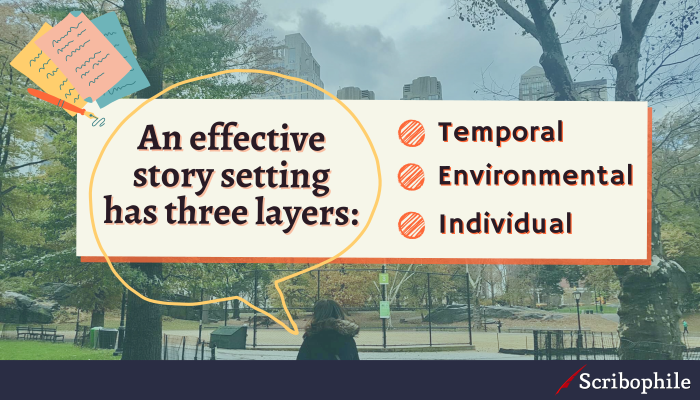
The second layer we are going to look at is probably the most obvious. It isn’t also the second most important or the second one you work on. That’s just the order I’m going in at this time. So, let’s look at:
Environmental or Physical Setting
This level of setting is what the characters can interact with. It can include the terrain, weather, and the overall world. In other words, this layer is what most people consciously think of when they hear the word ‘setting’. It is the tangible world the characters live in as they go through their adventures. You’re bound to create some of this as you go along because you can’t have them travel through a void.
One of the pieces of advice I would give to someone in terms of setting is to touch on all five senses. Don’t only talk about what people see. There should sounds, smells, and tastes to the world as well. When I write a descriptive paragraph to set the stage, I try to hit as many senses as I can. Touch is a difficult one, but you can do that by talking about the wind and climate. If you can hit all 5 senses, you can pull an invested reader into the world and lock them into what is about to happen. Of course, you have to remember to keep moving away from sight and maintaining this, which is the bigger challenge.
Even dialog can be used to enhance environmental setting by having characters point things out. They can discuss regions that are far away to increase the size of the world and maybe foreshadowing a future adventure. It isn’t the cleanest way to do it, but it can create an attachment between the world and the character. They are no longer a fictional figure passing through a fictional world, but an inhabitant of a vast, thriving dimension. This is why an author might have to consciously avoid adding to this setting, which would be weird. Why would someone want to write a story with nothing for the characters to interact with?
Another aspect of the environmental setting is that it changes as the characters move to other locations. Similar to time passing, the physical setting has to change. There is an evolution occurring within the setting to make it a bigger, deeper world. For years, I’ve called the setting another character because it changes and influences the story and vice versa. So, you need to consider such changes as you progress through the timeline or you’ll end up with a hodgepodge world.
While this aspect of setting tends to be a ‘given’, we still make mistakes. What suggestions would you give a new author when it comes to physical setting? As a reader, what have you run into with physical setting that jerks you out of the story?







Great post, Charles. I particularly like the concept of activating all of the senses.
LikeLiked by 1 person
Thanks. It’s been my go-to tactic for a long time.
LikeLiked by 1 person
I think it is a good one. The more sensory links people have to something the more they remember and relate.
LikeLiked by 1 person
Excellent advice! As for suggestions: don’t just name a town or city. Include information about the setting and the characters’ reaction to it. That might seem obvious. But I’ve seen manuscripts in which the authors didn’t mention much about the setting—even basic things like the weather and its effect on the characters. Characters interacted with each other. That was about it.
Another suggestion: be realistic about the size of an area and how far a character on foot can travel in a day. If your setting is huge, no one should instantly arrive anywhere, unless that person teleports. As for what might run me out of a story (besides the lack of setting details): mentioning fruit or other plants growing in the wrong season or land formations that a particular region is not known for.
LikeLike
Fruit and crops is a tough one. I don’t typically know that info, so I plop down whatever I think works for the local culture.
LikeLiked by 1 person
At least you’re putting something in. Some authors don’t put any information in. I’m not a gardener, so I have to look things up when I edit a book.
LikeLike
I’ve done some research for big fields and orchards.
LikeLiked by 1 person
Great post. I do fine with big picture stuff like mountains, oceans, and planets. I have to slow down when it comes to living rooms, parking garages, and smaller settings.
LikeLiked by 1 person
Rooms are tougher. They aren’t uniform or similar like natural structures.
LikeLiked by 2 people
Great advice. I can smell the clearing.
LikeLiked by 1 person
Thankful thanks. 😁
LikeLiked by 1 person
Setting is always tough since the show don’t tell conundrum comes into play. I tend to deal with setting through the character, touching walls, Making too much noise on tile, that sort of thing. I should work more on settings and I think I will make that a priority on the next one. I would tell new authors to try to figure out how to bring a setting to life without describing it. Would be a good exercise..
LikeLike
That’s tough to do. Leave too much up to audience imagination and you get a mess. I still do 1-2 paragraphs of general description of a new place. Then I sprinkle in details.
LikeLiked by 1 person
😊
LikeLike
My advice to a young writer would be to not try and describe every little thing, but instead choose key details that will have some significance in the story.
LikeLike
Good advice.
LikeLike