
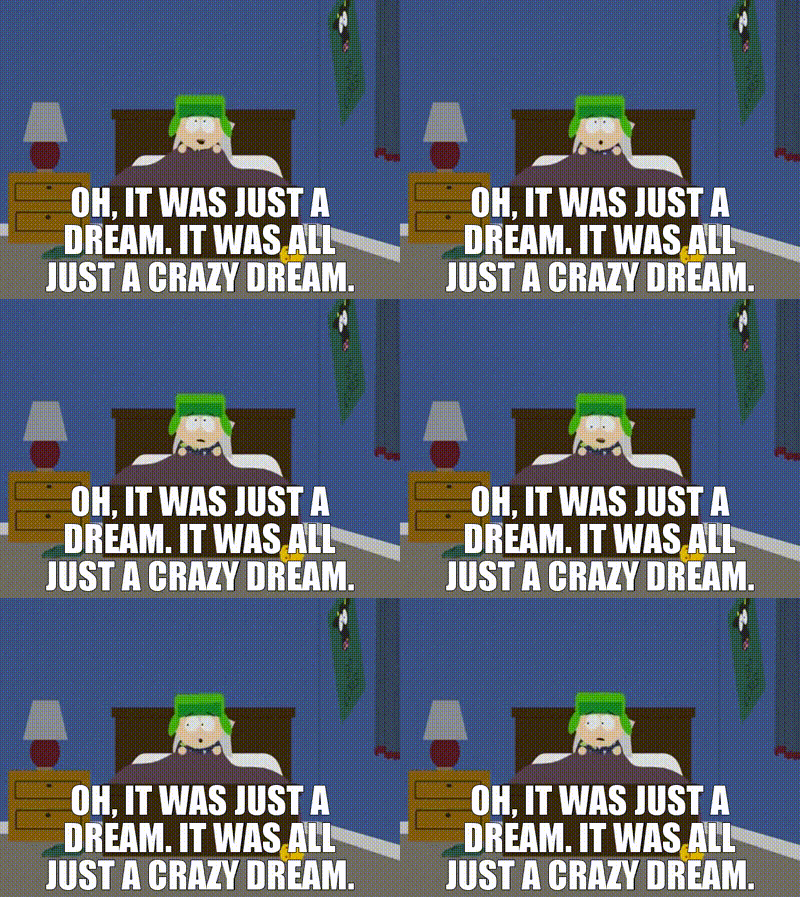
South Park
This is a very common ending that I’m sure all of us have encountered. After all of the events, the main character wakes up and it’s revealed to have been a dream. I believe this was the ending for ‘Newhart’ and it also makes me think of ‘Wizard of Oz’. From what I can tell, there are two uses for this trope:
- Having everything be a dream comes as a shock ending. The audience is surprised, but not upset. At least, that’s how it used to be. I think this usage doesn’t hit as well due to previous overuse and readers being hunters of foreshadowing. If you don’t show any signs of it being a dream, they’ll say you made a bad ending. To be fair, if you have signs and they figure it out, they’ll say you’re predictable. This is why I want to steer clear of it in my own stories.
- A more accepted and useful method is to have it happen in the middle of a series. This can reset characters and plots back to before the dreaming. It can help if an author has written themselves into a corner and have a previous event that could explain a coma or any form of unconsciousness. If it’s planned, an author can experiment with characters to see if anything is worth establishing in the real world. Either way, you now have a hero remembering a dreamworld and that gives you a subplot for them reacclimating.
‘Just a dream’ is still a risky endeavor in this day and age. I can see how it was shocking and popular long ago. Similar to ‘I am your father’ being said by the villain, this trope was used to the point where it lost its power. It only works on those who haven’t read or watched many stories that utilize the twist. So, they are shocked since it’s new to them, but everyone else might just shrug. This limits your audience to a very narrow population, which can shrink more once they realize you aren’t the first to do it. So, why would anyone use it again?
The truth is that sometimes the ‘just a dream’ twist simply works for the story. This can go for any trope since they became that way due to effectiveness. Even if you remove the shock effect, a character being in a coma and going through a fake adventure can open the door to many things. I already mentioned them having to acclimate to reality, which can be disorienting. Another option is the character hating the real world and setting off to see if they can return to the fake one. This does remove the trope from being a true ending, but more of a catalyst for more. It can extend the life of a series in this way since you can’t use it at the start.
When you use it is another good point I should touch on. Having a character start off waking from a vivid dream can be done, but the audience won’t have any interest in any effects. They won’t understand why the real world is better or worse than the fake one because they don’t know what was ‘lost’. You lose that investment and replace it with a mystery that can easily fall flat if it doesn’t grab the reader immediately. This is why ‘just a dream’ can work better as a mid-series twist. Placed there, you allow the reader to see both worlds and how they merge. They could even relate to the disorientation of the character since they have to figure out where the dream started.
Another positive for this trope could be seen as rare because it depends entirely on how philosophical the reader is. One can start trigger a discussion about reality and if we are in a dream right now. Maybe it can be about how people perceive things differently or anything about how we see the world. After all, the character experienced a dream so real that it was a story worth sharing with the reader. It was enough for them to also remember after waking, which isn’t always the case with dreams. They tend to fade away pretty quickly or remain solely as fractured shards.
So, what do other people think of ‘just a dream’?






I’m dating myself, but I recall a series finale that effectively used this trope. This was the end of the 80s show, Newhart, in which he was an innkeeper. Suzanne Pleshett, the actress who played his wife in his previous series in the 70s, was shown with him in bed. The punchline of the scene was that the whole 80s series had all been a dream. A brilliant way to end that series.
I also recall it used in the series, Dallas. Bobby Ewing had died in one season. But in the next his wife discovered “it was all a dream.” I think that was controversial.
And there’s Alice in Wonderland, where Alice wakes up and discovers her adventures were all a dream. I’m okay with that.
LikeLike
Newhart and Dallas were what I was thinking of. Never saw either one though.
LikeLiked by 1 person
Sorry. I missed that paragraph when I read the post. You mentioned Newhart.
LikeLike
No problem. I think that’s the one that did it best. Dallas, from what I read, got heat for it.
LikeLiked by 1 person
An excellent discussion, Charles. I had forgotten about Newhart!
LikeLiked by 1 person
Thanks.
LikeLike
I loved the Newhart ending. It was so unexpected. I used something that wasn’t a dream but an imaginary adventure that the characters themselves could have ended. It was like a group hallucination Those that read the series and reviewed the last book liked it.
LikeLiked by 1 person
That sounds like a nice twist on this type of ending.
LikeLiked by 1 person
Thanks.
LikeLike
Sometimes it works, and sometimes it doesn’t. I’m old enough to remember when the series, Dallas, tried this, and it’s been a joke ever since. The Newhart ending, however, was brilliant. You know, I just appeared in the Wizard of Oz as Uncle Henry in our Community theater, and it caused me to go back and read the books. (I’m on about book 20 of the 40 Oz books). In the Wizard of Oz, it was not a dream in the book. In fact, in subsequent books, Dorothy moves permanently to the Emerald City and brings Aunt Em and Uncle Henry with her when the farm doesn’t recover from the tornado.
LikeLike
Good point. I never read the books, but I did read how it wasn’t a dream there. Wonder why they changed it for the movie.
LikeLiked by 1 person
Maybe to hire fewer actors. There were a lot of other differences from the book. No miss Gulch. No Glinda. She appears in later books.
LikeLike
I loved the Newhart ending because it was pleasant inside joke if you were a fan of the Bob Newhart Show. I found the same thing with some surprise characters who played King Arthur in various remakes of Robin Hood.
LikeLike
I’m unfamiliar with the King Arthur inside jokes. Who was he played by?
LikeLiked by 1 person
Two I am thinking of are Robin Hood Prince of Thieves and Robin Hood Men In Tights.
LikeLike
Got it. Think I heard of the joke for Stewart. Totally forgot about Connery.
LikeLiked by 1 person
Found this blog through Perplexity today as I was doing research for a novel I’m starting soon. I like the just a dream ending of Alice in Wonderland so I think I’ll be using it too. I don’t think there’s anything wrong with it even though I’ve heard people complain about it. For fantasy stories it brings the reader back to the reality so we can go on with our lives. I like the idea of putting character bios on a blog so maybe I’ll do that too. Hope your parenting and writing journey is blessed. Cheers.
LikeLike
Thanks. Good luck with your projects. You’re right that the ending isn’t a bad thing. The issue might be how it’s used at times. Could be seen as a cop out finale to avoid closure.
LikeLiked by 1 person
I have made use of dreams, like the trauma dreams in “Swamp.” Not a fan of the Bobby Ewing ending. It worked for Newhart because it was a poke at things like Bobby Ewing.
LikeLike
Didn’t realize Newhart was a poke. Thought that was just a better way of using it.
LikeLiked by 1 person
I’ve never been a fan of this trope. Even as a child. I remember being very disappointed to discover that Alice’s trip down the rabbit hole was just a dream, and I had similar feelings about The Wizard of Oz.
LikeLike
I figure it’s not for everyone. Many don’t like the break in fantasy or the trick.
LikeLiked by 1 person
I would never use an ending like this. Perhaps in the middle of the story, where the protagonist was spurred to further action. But I hate these endings and would never do it myself.
LikeLike
I haven’t had a story in my mind that would work with it. Still, I guess it’s always possible. I know I’d make it clear the story is a dream from the start too, so I’d ruin it.
LikeLiked by 1 person
But if the character knew it was a dream, and it was something they fought their way out of, that approach would work for me.
LikeLike