
The quoll is a small, carnivorous marsupial with 3 species in Australia, 2 in New Guinea, and 1 in Tasmania due to going extinct on the mainland. They are listed as either endangered or near threatened. One of the main causes for their decline is the introduction of the cane toad, which is poisonous. Quolls don’t know any better and will eat this invasive species then die. They are also competing with and hunted by non-native foxes and cats, losing habitat to urbanization, and killed by poison that is placed out for other pests. Interestingly, the poison is a natural one used to eliminate invasive animals, but juvenile quolls have shown to be susceptible as well. Studies are being done to look more into that situation as well as reintroduction plans, eliminating foxes on the smaller islands, and breeding programs.
So, what are some quoll facts?
- Quolls mate during winter.
- A female will give birth to nearly 30 joeys, but only 6-7 will survive due to available teats. Remember that marsupials give birth and then the rice-sized joeys need to climb to the pouch in order to latch on. So, giving birth to many increases the chances of having surviving children.
- A quoll litter can have joeys from multiple fathers.
- Female quolls will primarily birth males in their first few litters and then more females in their latter ones.
- Males tend to die after the first time they breed.
- They reach maturity at 1 year and live around 3-6 years in the wild.
- In the early 1800’s they started being called ‘tiger cat’, ‘native fox’, and ‘native cat’ due to their appearance. David Fleay fought to have them be called quolls again in the 1960’s because he felt the other names were misleading. Quolls are not related to cats or foxes.
- Their closest relative is the Tasmanian Devil.
- Quoll sizes range from 300 grams to 7 kilograms and 25 cm to 91 cm (not including the tail) depending on the species.
- Smallest is the Northern quoll and largest is the Spotted-Tailed or Tiger quoll.
- While fur color can range from black to light brown, they all have white spots.
- Only the Spotted-Tailed quoll has a true pouch. All other species develop a skin-fold pouch during pregnancy.
- Quolls are biofluorescent, which means they glow in the dark.
You know which picture I’m showing first:
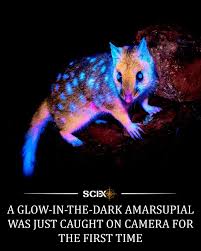
This is under ultraviolet light, so it is does seem to be exaggerated.

Eastern Quoll (Found on Tasmania, but being reintroduced to mainland.)

Spotted-Tailed or Tiger Quoll

Northern Quoll

Western Quoll

New Guinean Quoll

Bronze Quoll (New Guinea)





 Legends of Windemere
What an amazing animal and I’m so happy that there is a conservation effort. They’re actually kind of cute. And so many joeys in one pouch!
LikeLike
I feel like Australia and New Zealand have a lot of conservation programs. Nice to see places where such things are common and taken seriously.
LikeLiked by 1 person
Absolutely!
LikeLike
Glowing in the dar might put a crimp in the hunting routine. An interesting animal, Charles.
LikeLike
I wonder if it helps attract prey.
LikeLiked by 1 person
That must be the reason. Like a lantern fish.
LikeLike
Pretty unique among land based creatures.
LikeLike
True.
LikeLiked by 1 person
Sort of like a squirrel, sort of like a cat? Very interesting critter.
LikeLike
Australia does seem to have a lot of combo critters.
LikeLiked by 1 person
A lovely little animal. It’s so good that there’s a conservation effort.
LikeLike
Hope it continues to be successful.
LikeLike
I so enjoyed this!
LikeLike
Thanks.
LikeLiked by 1 person
You’re welcome.
LikeLike