
This creature is found in Southeast Asia and it’s name doesn’t really tell you the truth. It is not a lemur and it doesn’t fly. As with the flying squirrel, it glides using flaps of skin that run from their necks to their limbs and tail. I guess ‘gliding lemur’ doesn’t have the same ring to it. Although, Colugo sounds pretty cool.
Both species of Colugo are in danger due to habitat loss. They are also hunted for meat and fur, but it is mostly the destruction of their home. The Philippine Colugo was listed as vulnerable since it was under more of a threat. It is also the primary prey of the Philippine eagle, which is critically endangered. This means the Colugo population decreasing threatens another species that is in greater danger. Really shows how nature involves connected organisms and systems.
Here are some facts:
- The only species are the Sunda Colugo and Philippine Colugo.
- Their closest relatives are primates, but they diverged around 80 million years ago to become an ancient lineage.
- Family name is Cynocephalidae, which means ‘dog head’ in Greek. This is because of their broad, short-snouted heads.
- Order name is Dermoptera, which means ‘skin wing’ in Greek.
- Webbed feet and light skeletons help them to become the best gliding mammal in the world.
- Their incisors are comb-like to help with grooming.
- Other unique dental structures are upper incisors with two roots, no canines in upper jaw, and molars with sharp edges.
- Colugos can glide for about 230 feet before they start losing altitude.
- As good as they are at gliding, they are awkward climbers due to not having any thumbs. They have to hop up the trunk.
- They are nocturnal and only glide when their tree is out of food, want a mate, or need to protect their territory.
- Their big eyes allow for night vision and great depth perception.
- While Colugos are not marsupials, they raise their children by keeping them in a ‘pouch’ for 6 months. This ‘pouch’ is made by the mother using her skin flaps while the 35 gram baby clings to her belly.
- A reason deforestation is a problem is because the removal of trees makes it more difficult for the Colugos to travel. Fewer trees means longer distances of gliding, which can expose them to predators or force them to try hopping along the ground.
Pictures from Wikipedia and video time!
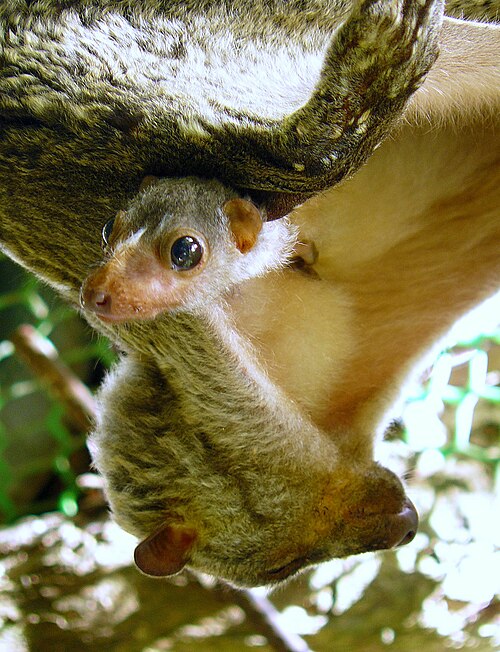
Philippine Flying Lemur
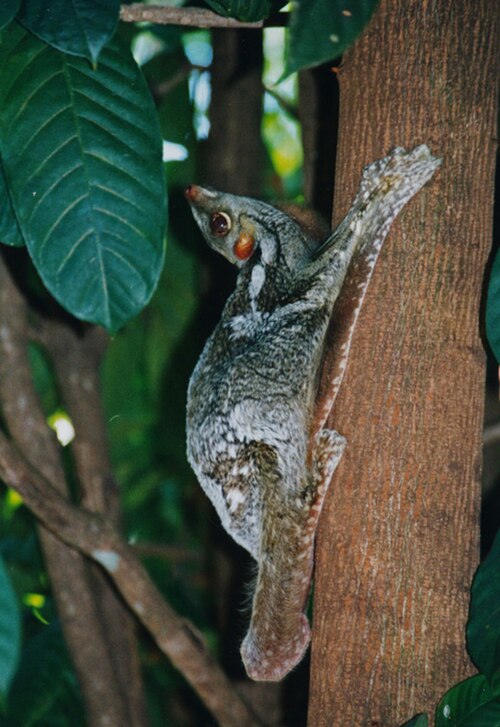
Sunda Flying Lemur





 Legends of Windemere
Fascinating, Charles. Thanks for sharing.
LikeLike
You’re welcome.
LikeLiked by 1 person
Another strange creature I had not heard of. They look like flying laundry in the air.
LikeLike
I enjoy stumbling onto weird animals and sharing here. Definitely gives off ‘shirt stolen off laundry line by the wind’ vibe.
LikeLiked by 1 person
Thanks Charles, I enjoy reading them.
LikeLike
It does look like a flying shirt! What a fascinating animal. What happens to the baby if the Mom has to move?
LikeLike
My guess is they cling tight like with possums and other arboreal mammals.
LikeLiked by 1 person
Cute little guys.
LikeLike
Totally.
LikeLiked by 1 person
What a cute little animal. I hope they don’t become extinct.
I used the gliding with a flap of skin in my duo, Elemental Worlds. In the world of Air, some people have developed similar flaps of skin and can glide. They have become the elite and those who can’t ‘fly’ are their slaves.
But I based them on flying squirrels, not having come across these creatures before. Thanks for telling us about them.
LikeLike
Flaps of skin fur gliding seems fairly common in the animal kingdom. Isn’t that how bat wings work too?
LikeLike
No. Bat wings are true wings. If you watch a bat, you’ll see it flies around, changing direction as it chases insects. You can’t that by gliding. Also, they don’t gradually descend.
LikeLike
Sorry. I misspoke on my reply. I meant that the wings still were stretched skin. Didn’t mean they were gliding instead of flying.
LikeLiked by 1 person
I enjoyed learning about these new-to-me beasties!
LikeLike
Glad to share.
LikeLike
This animal is so interesting, Charles. Thank you!
LikeLike
You’re welcome
LikeLiked by 1 person