
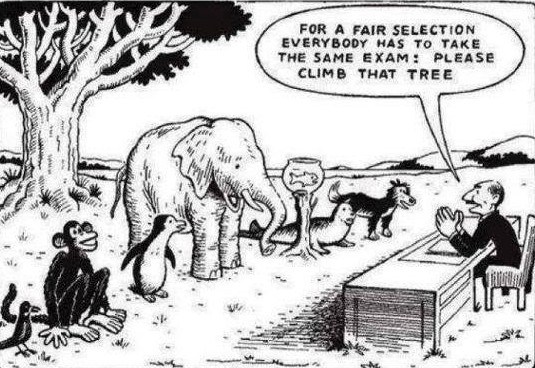
Google Image Search
As this school year comes to a close, I’m wondering what some people think about education. I know this is a dangerous subject, especially since I’ve found that many don’t know how our system works. The amount of times I’ve had to explain how the DOE, state tests, state standards, and other things work is crazy. Doesn’t help that I’m just a TA, so I’m not a reigning expert. Anyway, let’s try to keep this civil and sensible.
- If you could change one thing about our education system, what would it be? (Do not say pay teachers more because that’s a given.)
- What do you think is the hardest part about being a teacher today?
- What do you think is the hardest part about being a student today?
Also, I do want to mention something that I’ve run into every year. Somebody always talks about teachers getting the summer off, which makes it an easy gig. The reality is that many teachers don’t really take the time off. Many teach summer school, do their mandatory professional development, get certifications to improve their knowledge base, prepare lessons for the next year, go to events that help them learn about the changes in their subjects, and other things that can’t be done during a normal school year. All of this is during a period where one doesn’t get a paycheck until September. So, don’t think that summer is always smooth sailing even if a teacher can get a week or two to do nothing at all. Most really don’t.




 Legends of Windemere
My son-in-law is a science teacher in a pupil referral unit in inner London – very small classes, but challenging pupils who couldn’t cope in regular schools. We were just talking about school systems set in a rigid way – why do we assume it’s okay for young children, any children to be expected to sit still indoors for hours on end. A good run around at regular intervals or ‘forest schools’ , learning outside.
LikeLiked by 1 person
I think it’s because modern education was originally designed to create factory workers. So, sitting still and doing a repetitive task was essential brainwashing.
LikeLiked by 2 people
LikeLiked by 1 person
It’s funny. Many schools do have Career Training programs that can lead to certification. Yet, people without kids don’t know this because it’s never advertised. For example, my son is in one for multimedia. They have some for business, technology, and artistic career paths.
LikeLiked by 3 people
We had a math teacher who used to take us on field trips to apply the lessons in practical settings. Those lessons were the best, in my opinion, and I still remember them.
LikeLiked by 2 people
That had to be fun. Don’t think I’ve ever heard of a math field trip before. It’s usually science and history departments doing them.
LikeLiked by 1 person
It was a lot of fun. He also included some history behind the math on how it was used by Roman armies and for navigation.
LikeLike
Don’t get me started!
I can’t talk about the US system of education as I know next to nothing about it, so my comments are based on the UK system. And I was a science teacher in secondary schools.Every child in the UK is taught the same things in the same way in most schools, allowing for differences in ability. (It wouldn’t be expected that a child who had difficulty with maths would be taught calculus, for example.) Things are taught in an academic way. But everyone doesn’t learn in the same way, nor at the same rate. As someone said, those who learn by being hands-on should be taught in that way. The teacher who took his classes on field trips to learn the use of maths had it right. Too many children can’t see the reason for learning a particular subject.The hardest part is controlling the pupils. But it’s little wonder, as they aren’t invested in what they are learning. There was a wonderful film (from a book) called Kes, about a boy who was considered difficult and not very bright at school. Then the teacher discovered he had a kestrel, called Kes, and knew a huge amount about birds and falconry. The teacher used this and transformed the boy.
Students today are put under so much pressure to pass exams. I took exams, and so did everyone I knew, but I don’t remember there being so much fuss. I think it’s partly from the school, who want to get as many children passing exams as possible for their ratings (We get lists of the best performing schools. They mean nothing, though, as the ‘best’ schools are either private or in middle class areas.) The authority I worked for in the 1990s did a ‘value added’ list. They took the results of year 9 SATs and extrapolated them to see expected GCSE results at year 11. On raw scores, the school I worked at came at the bottom, or close. With the value added, we were top. We added more to our pupils than the school that had previously been top on raw scores, who, incidentally, came last! (They are a selective school who takes pupils on their academic ability.)
Sorry to have made such a long comment, but it’s something I think should be seriously looked into.
LikeLiked by 1 person
The sad thing is that the variety of learning styles has been looked into. I remember being taught about this when I was taking teaching courses in Florida. Yet, the answer was to create lesson plans that touched all styles, which is nearly impossible when you have a 40 minute period. You can’t give individual help either, so it has to be done to the whole class and hope for the best.
Standardized tests is a big reason for this ‘one size fits all’ mentality too. Students are basically hustled from one test to the next because the State has set a schedule. No time for papers, projects, fun reading, or much else beyond your regular lessons. Add in parents who barely pay attention and toxic social media then you get easily distracted, distant students.
I remember being told that the US tried to change things long ago. At least some areas or maybe just New York. Either way, the plan was to give every student an Individualized Education Program like special education students. It was dropped because of the cost, which adults complained about since it could cause a tax increase. So, nothing was done and we got a slew of bad ideas. No Child Left Behind ignored the middle 50% of students and stopped the concept of failing a grade. Everyone moved on regardless of ability. Then Common Core Curriculum arrived to treat everyone like a clone and wipe out the rest of individuality. Both pushed standardized tests further into the system as well. Just a mess.
LikeLike
Thanks for the soapbox, but I don’t think I’ll step up. I’ll just say that I’m glad all my kids made it through and graduated. Glad to leave all that behind.
LikeLiked by 1 person
It’s definitely not the same system anyone remembers. I think part of it is because politicians love messing with education. If they say it’s for the children, people applaud even if it’s a disaster when initiated.
LikeLiked by 1 person
Agreed.
LikeLike
LikeLike
Sadly, projects aren’t very common these days. It’s primarily lesson, test, lesson, test, etc.
LikeLike
I work as a special ed paraeducator, so bear that perspective in mind.
LikeLike
Totally agree with all of this.
LikeLiked by 1 person
Except I meant RE-SEGREGATE schools, not integrate them!
LikeLike
I’ve always like this one.
LikeLike
Thanks.
LikeLiked by 1 person
You’re welcome.
LikeLike