
Yahoo Image Search
This is a post I wrote about parenting and autism back on May 3, 2021. I thought it would be good to trot it back out and even edit stuff a bit with my current knowledge. Enjoy even though it’s pretty long:
I work with autistic and other neurodivergent students who are at various levels of the spectrum. I’m the parent of an autistic child who is high on the spectrum. I’ve taken classes on how to work with these kids and learned from own experiences as a parent. Yet, I can’t stand here and declare myself as someone who can talk at length about autism. Part of it is because I am not autistic, so I do not have the hands-on experience that my son and students do. Also, it’s a spectrum for a reason and that’s because it’s not the same for everyone. When younger, my son responded to a reward system to help him deal with transitions and minimize negative behavior. He has since grown out of that, but still requests rewards for difficult tasks. Others don’t care about such things, so you need to find alternatives. So, I can only talk about what I know, which could be entirely different from what another special needs parent believes.
Truthfully, the biggest tool in a parent’s belt is patience. There will be great days and nightmarish days, but you need to be patient and calm. Not all the time though because you will slip at times. It can be stressful and nearly every parent has a moment where they yell or cry or make a mistake. This can be painful and disheartening because it can be a shock to their system, which may trigger a meltdown. You walk away feeling like you’re a terrible parent, but you’re only human. As long as it is not a constant screaming, you haven’t destroyed the relationship. Thankfully, this frustration is temporary because you eventually calm down and return with a clearer mind. After all, you love your child even with the challenges. At least, that’s what should happen. There are situations where a great mistake occurs and causes lasting trauma.
Many people believe is that those who are autistic can’t feel emotions. I’ve met parents of autistic children who act like they’re working with a heartless robot when that’s not the case. Even someone who is nonverbal has emotions. They can become scared and angry and sad. They can be happy and recognize they are loved even if they don’t understand the emotion. A parent who loses their patience can do lasting damage if they don’t return to show they still love the child. Soft voices, hugs, kisses, or anything that will show you aren’t angry any more, but it depends on the child. Some don’t like physical contact when they are overstimulated. More importantly, you should genuinely apologize for your behavior even though you are the parent. This is essential regardless of if a child understands the words because they will read faces and voice tone. Again, this is from my own experience.
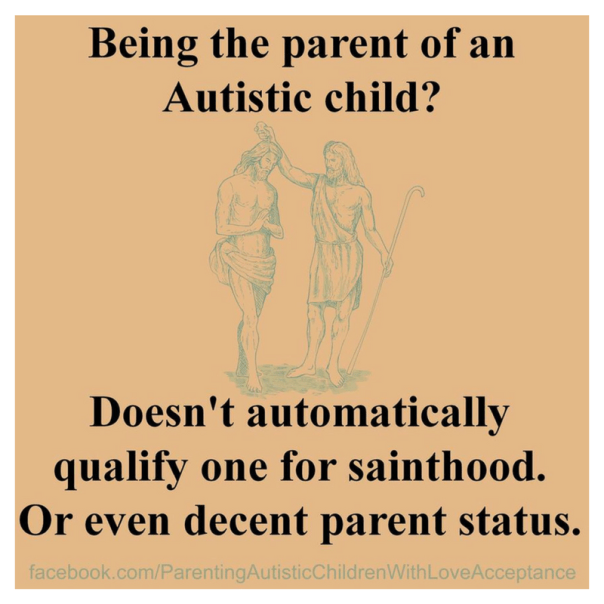
Now, you might be wondering about the image at the top since I’m saying mistakes happen. Well, that statement is true, but there’s a difference between mistakes and being a shitty parent. I’m being kind of blunt, but I’ve seen it happen. First, you have parents of autistic children who deny they have it even after a diagnosis. This results in them forcing the child into situations they can’t handle without accommodations or are beyond the skills that they currently have. They won’t suddenly learn everything they need while under stress, so damage is done to their progress. Sometimes it creates negative behaviors that are incredibly difficult to reduce or eliminate by the time they are older teens or adults. Commonly, those with autism need routine or consistency, so they won’t break away from their comfort zone even if it such a place includes negative behavior. I feel that this is easier to handle when the child is younger because all kids are dependent on their parents early on. So, they won’t feel different from their peers when their behavior is being adjusted, rewarded, or punished even in public.
Let’s get to the punishment part now. By punishment, I mean the removal of something they enjoy. I’ve done this before and it’s a habit I try really hard to break. This is fairly self-explanatory because we’re used to it from long ago. We do something bad and get grounded or having something we love taken away. This makes us not want to make that mistake again. With autism, you’re coming up against a variety of factors that can include impulsivity, inability to connect actions with consequences, and anxiety in regards to transitions. So, they may impulsively do something we perceive as wrong. The parent bans their favorite TV show for a month, but they can’t see this is associated with their actions, especially if their mistake wasn’t TV show related. All they know is they are being punished and their comfort zone has changed to no longer have a relaxing activity, so they are upset. This can be traumatizing and lead to more negative behaviors instead of a reduction. Parents who continue doing this when it clearly increases anxiety become a problem, especially if they refuse to stop in the face of growing issues. It can create some terrible habits as well. For example, a child makes a mistake and goes right into a meltdown before an adult can respond due to fearing punishment. One could call this a trauma reaction.
It’s better and more effective to go with a reward system that is immediate. Stickers, candy, TV time, and anything else that is simple and they love will work. I used to do sticker systems with my son to help him with eating. When he earned enough, he could trade them in for a bigger prize such as a Funko Pop or Lego set. The reason this differs from punishment is because it’s all positive. For example, a child refuses to eat dinner and you respond by taking away their favorite bath toy until they do what they’re told. Even if you get them to eat, it isn’t a strong achievement and can fall apart due to it being a negative creation. Instead, you tell them that they get a sticker of their choice for every meal they eat. Now, failing doesn’t result in them losing something they have already gained. It means they didn’t earn a sticker and can try again the next day. The more times they succeed, the stronger the positive behavior is and the reward system can slowly fade away. Of course, it’s important to explain this to them and be consistent. I was told that you want to have the rewards be solely for that event too. This is why I had candy for my son eating his lunch and stickers for breakfast since the two meals had different behavior issues.
I’ve just kind of ranted here, so I hope I made some good points. Parenting an autistic child is always a challenge that changes as time progresses. You find new methods or the child develops new habits, so you never know what the day will hold. That’s why patience is important as well as accepting that this is how your child is. Not to the point where you don’t try to help them learn and develop coping mechanisms. Acceptance means that you understand that things will difficult and you need to focus on the child that you have instead of the one you wished you had. That sounds cruel, but I’ve met a few parents of autistic children who talk about curing them and gaining the child that they always dreamed of. Hurts my heart there because while these parents are thinking of a child that doesn’t and will never exist, they are ignoring the unique child that they have.
2025 Add on– These days I don’t do many reward systems with my son. He acts like every other teenager with fighting me on homework and waking up in the morning. The big thing with his is that he has trouble understanding social situations and various ways of speaking. Many people with autism will take things literally and he’s like that. So, wordplay and idioms confuse him. I just have to be careful how I explain things and still be patient. All that being said, he does really well in school and has friends that he tries to interact with. His fixations still get the best of him when he’s not focused on anything, so he’ll go for Yugioh and Pokemon instead of breakfast or homework. This is where reward systems still come into play. If he does what he’s supposed to do in the morning, he gets to play Pokemon Go on the way into school. If he does his homework correctly and quick enough, we can go out for some PoGo in the park or games on the Switch. This doesn’t feel any different than with anyone though. We all have rewards that we require for doing various tasks. I mean, a salary and benefits are pretty much a reward for working. If an employer doesn’t give us that, we’ll go off and find them somewhere else.





 Legends of Windemere
Good idea to bring this back out, especially with the 2025 addendum. It will help parents who are feeling overwhelmed or unsure what to do to know what other parents are doing.
LikeLike
Thanks.
LikeLiked by 1 person
Great advice, Charles. The idea of a reward system can be applied to most child/parent interactions. It is much more pleasant to offer an incentive than to take away a privilege.
LikeLike
That’s the reasoning behind it. I also think a reward system helps them prepare for the adult world since that’s how we work. It isn’t obvious, but money and benefits are technically a reward for working. I don’t think most people would do their jobs without getting those in return.
LikeLiked by 1 person
So true.
LikeLike
Above all, an autistic child i still a child, your child, and deserves consistency of bahaviour from you, rukes and guidelines but above all, unconditional love. The reward situation works for non-autistic children just as well and many autistic children can pick up on this from situations outside the home. This may help them understand that they are not singled out for parental guidance just because of their condition. Children high on the autistic spectrum are often aware if they are treated differently and may question this.Parents neeed to be honest especially if they are in a negative reinforcement (punishment) situation. They need to explain the punishment i.e. deprivation is a temporary measure only.
Wewll done Charles, you seem to be doing everything the right way and I’m sure he knows how much he is loved and valued. Hugs
LikeLike
Thanks. Though explaining even temporary punishment is difficult. Many autistic children live in ‘the now’ and won’t think of the future. They don’t always connect negative consequences with previous actions either, especially if there’s a delay between the two. I believe this is why punishments aren’t used much and it’s a simple ‘do this to get this’ system.
LikeLike
Still a relevant post, and the update was great.
LikeLike
Thanks.
LikeLiked by 1 person
Throughout my life, I’ve occasionally been told with a tone of surprise and sometimes even a you-look-okay-to-me facial expression of doubt: “But you’re so smart”. Today, I would reply with frustration: “But for every ‘gift’ I have, there are a corresponding three or four deficits.” It really is crippling, especially on a social level that affects employability.
I’m still ‘undiagnosed’, though that means little to me. An official diagnosis would cost a lot of money due to our [Canada’s] “universal” healthcare system not really meaning universally accessible regardless of one’s financial status.
It’s an obvious condition with which I greatly struggle(d) while unaware until I was a half-century old that its component dysfunctions had formal names. … Then again, had I been aware back in the 1970s and ’80s I likely would’ve kept it a secret nevertheless, especially at school, lest the A-word [autism] gets immediately followed by the F-word [freak].
While low-functioning ASD seems to be more recognized and treated, higher (as opposed to high) functioning ASD students are more likely to be left to fend for themselves, except for parents who can finance usually expensive specialized help.
Either way, sound mental health as well as physical security should be EVERY child’s right, especially considering the very troubled world into which they never asked to enter. And not being mentally, let alone physically, abused within or by the educational system is definitely a moral right.
LikeLike
People tend to think of low-functioning autistics when they hear the word ‘autism’. High-functioning get the same shock that you and my son do. The school district my son is in is great with special needs children as is the one that I work in. So, it really is a district-by-district situation down here in order to get the proper diagnosis and help. We have plenty of state programs that will get the ball rolling without any issues too. I’m guessing that’s the same everywhere.
LikeLike
This is a great read. Sometimes I appreciate that fact that I am also autistic and seem to instinctively know what’s up with my kids and how to handle it. I still don’t always get it right and the learning curve has been STEEP! There is so much to learn for all of us.
LikeLike
You’re welcome. Definitely a steep curve since every person is different. What works with my son won’t work with my students and vice versa.
LikeLiked by 1 person