
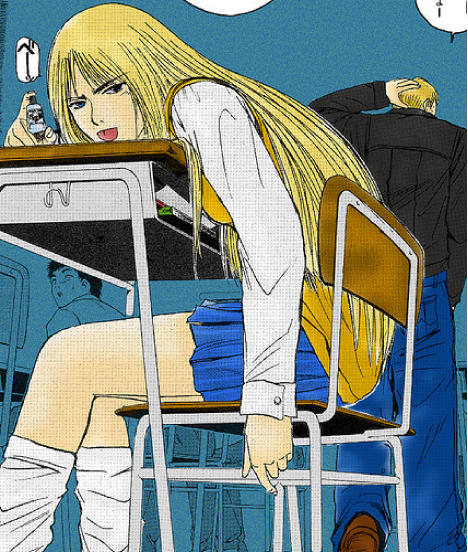
Irumi Kanzaki from GTO
So, this is the other character type I was thinking of last time I re-watched ‘Great Teacher Onizuka’. Now, the story is that Onizuka is a former motorcycle gang member who is determined to be a teacher. He gets a job at a private school where he is given a class full of students who hate teachers. The principal’s plan is that an non-traditional teacher like Onizuka can reach these troubled and rebellious teens when all previous attempts have utterly failed. For example, one of their previous homeroom teachers ends up quitting to stay at home eating snacks. Another I believe ends up in a psych ward, which is to show how dangerous these kids are. Keep in mind this is a comedy with dramatic, coming-of-age undertones.
While watching the anime and reading the manga, I did sense that the author was purposely going over the top. For example, Irumi Kanzaki up there (super genius with a traumatic past) pulls some messed up pranks such as blowing up trashcans around the school to break the windows. To be fair, that was when she was pushed into a PTSD trance type of thing. Prior to that, she almost got Onizuka arrested for being a pervert in public, made a garden snake look like a cobra before it bit him on the *censored*, and tried to get him into debt for buying them expensive sushi. He got out of that last one by doing a dine-and-dash then getting hit by a car whose driver he convinced to pay the bill as part of the damages . . . I said over-the-top.
I’ve done enough set up here, but I think going over-the-top is the best way to go with teenager delinquents. First of all, adults seem to have trouble writing these age demographic believably if they try to be serious. The immature teenager ends up acting older or younger than they are. This makes the audience have trouble either believing they’re a teenager or simply spending more time thinking about how they would have done things differently. I don’t know if there’s any way to effectively counter a reader forgetting that they are more mature than a teenager, so their decisions would differ, but it becomes a bigger issue for troublemakers. Why would that be?
If you don’t go over-the-top, you run the risk of their actions being unforgivable and any explanation of why they act like the do won’t matter. We live in a world where people are a lot less forgiving and understanding to both real and fictional characters. For some, it doesn’t matter that the teenager who has been stealing lunch money because their family can’t afford food. Wrong is wrong to these people and they will at the very least go negative on the family instead of realizing that a teenager might commit bad acts out of desperation or trauma. Empathy is lacking, which is why it could work better that these characters go big and the reader ends up being foisted out of escapism a bit to remember they are reading a book.
Perhaps another part of this is making sure nobody gets really hurt by the antics. Bumped around or ‘injured’ for a panel is one thing. Permanent or long-term injuries is when readers will think the teens have gone too far. Makes sense since this would get a teenager sent to juvenile detention at least in the real world. Yet, that ends the story and an author might want them to do something else for redemption. Again, we can run into an issue with an adult writing a teenager. While some decisions might be too mature, there is a habit to put the ‘act without thinking’ on a teenager character in order for them to injure another one. Kids are more aware of this possibility than we realize unless they are fueled by powerful emotions. Delinquents don’t always mean loners too, but authors tend to do a group hivemind thing with nobody pointing out the issue. If anyone does, they’re tossed out and we get ‘Lord of the Flies’. Remember that the dissolution of civility took maybe around two months and it was full survival. This would be within civilization, so teenagers won’t be as feral.
This is where I think ‘Great Teacher Onizuka’ really works out. Yes, the antics are almost cartoonish, but those that go too far tend to have at least one of the students wonder if they should stop. As the story progresses, those who accept Onizuka actively try to stop those who are still campaigning against the teachers. Maturity is gained in a fairly short period of time because of experience and finding an adult who listens, understands, and makes them enjoy things again. As I said, there is a coming-of-age aspect to this series as well as one about healing from trauma. Both of which can be helpful for teenagers even if they aren’t going through the same level as the characters.
Maybe these characters should be written primarily for their own demographic. Then again, adults might get some insight into how troubled teenagers think and act instead of always writing them off. That’s kind of hopeful.





 Legends of Windemere
agreed, doesn’t sound like real life!
LikeLiked by 1 person
Definitely.
LikeLiked by 1 person
Having raised a troubled teenager over the top is the norm. I remember coming home from work and seeing a very well-done Pink Floyd logo burned onto the garage wall with a torch.
LikeLiked by 1 person
That sounds pretty over-the-top. Although, not very surprising for a teenager.
LikeLiked by 1 person
It was an excellent rendering too.
LikeLike
Some adults tend to think teens act overly dramatic anyway, so they might like this. Some teens might think the writers are making fun of them if the antics are too over-the-top and might tune out. Everybody is going to have their own spin on this.
LikeLike
I wonder which is more likely though. I think teens would be more accepting or just ignore the character. It’s adults I see judge these types and thinking it’s normal or something. From having my own teenager to raise, I’m shocked by how often I meet adults who deem cries for help and acting out as nothing more the drama. No wonder so many get worse or turn down a bad path.
LikeLiked by 1 person