
I’ve had the giant anteater on my list of potential animal posts for a while. It was actually the whole anteater family, which is why it was going to take longer to put together. Then, I started learning about how the giant anteater isn’t as gentle as I believed. In fact, it can be downright aggressive. So, I’m going to focus on it with the usual conservation status and list of facts.
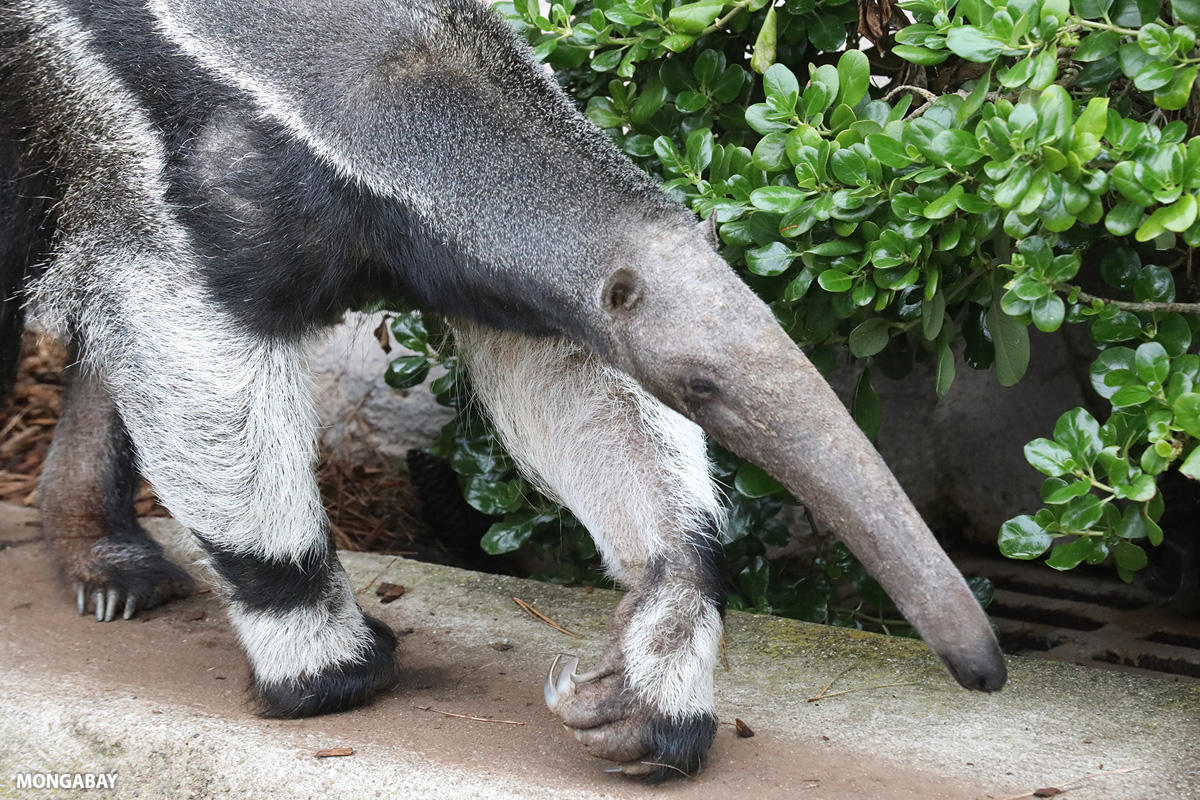
First, what is a giant anteater? These are big, hairy creatures found in Central and South America. From the name, you can tell that they eat ants as well as termites. They usually have a black and gray fur pattern with a really big tail. A giant anteater’s long snout helps with getting it’s long tongue to its underground meals. Rounding out the physical descriptions, we have really big and sharp claws.
The giant anteater is listed as vulnerable to extinct throughout its territory. This means it has been wiped out of some areas, but it lives and struggles in others. The main cause is the destruction and segmentation of its habitat. Much of the grasslands they live in have been turned into pastures for cash crops. The remaining areas are divided by roads and giant anteaters aren’t very good at looking both ways before they cross. Roads also split up populations and can lead to shallow gene pools. I find this interesting because it’s the first time I heard about this issue, but it’s probably fairly common.
So, what are some giant anteater facts?
- They can be from 6-7 feet long with males being slightly heavier than females.
- While their territories do overlap, they are solitary outside of breeding and mothers caring for their children.
- They live in grasslands and rainforests.
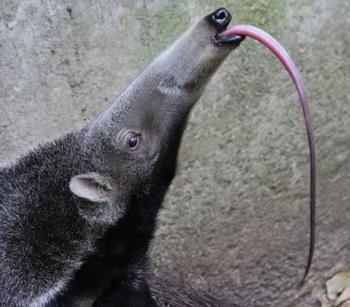
- Giant anteaters have their iconic snouts and sticky tongues, which are long and narrow to get into ant and termite homes.
- Their tongues are 2 feet long and is only 0.4-0.6 inches at its thickest point
- Their claws are big and sharp to help them dig into their prey’s home. This works very well for termite mounds, which are very strong.
- They can eat 30,000 insects per day.
- Giant Anteaters do not have teeth.
- They have poor eyesight, but their sense of smell is 40x that of humans.
- They get water by licking wet vegetation with their tongue.
- If they are threatened, they will bellow and stand on their hind legs to swipe at their enemy with their claws.
- Giant anteaters are typically diurnal, but will become nocturnal if there is a large human presence.
- Their bushy tail helps to confuse predators because it makes them unsure of which end is the front. Choose the wrong one and you can get a claw to your belly.
- Baby anteaters ride on their mother’s backs for around 6 months.
- They have one of the lowest body temperatures of any mammal at 91 Fahrenheit (32.7 Celsius).
- Giant anteaters can kill pumas, jaguars, and humans if threatened.
Now for the pictures and videos, which people always enjoy.







 Legends of Windemere
Lots of interesting facts we didn’t know about this strange creature. It’s a wonder there are any anthills left at the consumption rate. I wonder what the ants taste like, perhaps yummier than we imagine.
LikeLike
Crunchy with a bite. Funny thing is that an ant mound has at least 250,000 ants. So, the anteaters don’t take out the whole colony. Mature queens can lay around 20,000 eggs a day too. Those can hatch quickly.
LikeLike
I am reminded of the comic strip, BC.
LikeLike
Haven’t read that in years.
LikeLiked by 1 person
Fascinating, Charles. Thanks.
LikeLike
You’re welcome.
LikeLiked by 1 person
I hadn’t realised how enormous these animals are. Truly well named as giant.
Such a pity that they are endangered. They must perform a useful job of keeping the termite population down. I hope that corridors and underpasses can be built to allow them to pass.
LikeLike
I think Brazil did a study to find out the type of areas anteaters are hit the most. Something about straight roads with nature plants running right to the edge. Does seem that preserves have been made along with corridors after satellite tracking shows their territory patterns. Breeding programs are established too, which helps since they have a low reproduction rate.
LikeLiked by 1 person
I hope they are successful with the conservation. It would be a pity to lose such an amazing animal.
LikeLike
The second photo looks like a fashion model tossing her hair!
Really, nature comes up with the strangest and most interesting combinations.
LikeLike
True. Nature does better work than fantasy authors. Platypus puts all of us to shame. 😁
LikeLike
Yikes! 7 feet and a killer. This was fascinating, Charles.
LikeLike
Thanks.
LikeLiked by 1 person
You’re welcome.
LikeLike