
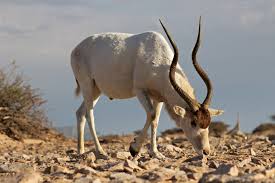
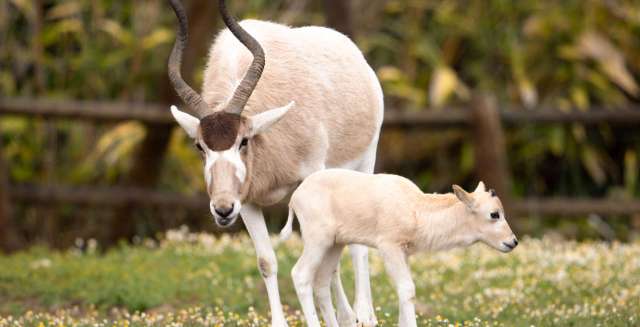
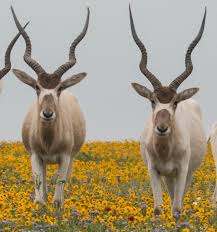
I don’t know where I stumbled onto this animal, but the Addax was sitting on my list. It’s an antelope that was hunting a lot for its meat and fur. Cattle farming has taken over a lot of their habitat as well. Though, one of the biggest causes is that they were casualties of both World Wars due to their range. There are less than 500 left in the wild, which only survived because Addax can live in environments that are too harsh for humans. Many zoos have breeding programs to help create more genetic diversity and work towards replenishing the species.
Here are some Addax facts:
- Both males and females have horns and shaggy manes.
- They are adapted to live in the Sahara desert and can traverse sandy areas, rocky regions, coastal plains, and grasslands.
- Addax have wide, flat hooves that allows them to walk on sand similar to a camel.
- Their pale coats reflect sunlight, which keeps them cool.
- Addax fur change color with the seasons to be lighter in summer and darker in the winter.
- They receive most of their moisture from the plants they eat.
- Their ability to conserve water results in dry feces and concentrated urine, so no usable water is passed.
- Herds can have 5-20 members with a dominant male.
- Females create a dominant hierarchy with the oldest being in charge.
- Gestation is 257-264 days and usually grants only one child.
- Their short legs make them very slow runners, so they can be caught by fast predators.
- Addax are hunted by humans, lions, cheetah, African wild dogs, and leopards.
Let’s look at some pictures and videos.






 Legends of Windemere
Pretty buggers. I knew they existed, but not much about them. Thanks.
LikeLike
Same here until I did the post. Glad you enjoyed it.
LikeLiked by 1 person
Thanks, Charles, for sharing about these antelope. I do enjoy seeing antelope in the wild. Some of ours in southern Africa are endangered too.
LikeLike
You’re welcome. We don’t have anything like that around. Deer if you go further north or east.
LikeLike
🌈💕
LikeLike
I like the shape of their horns, and the darker “mask” on their faces. What beautiful creatures.
LikeLike
Thanks.
LikeLike
I saw something on TV about moving some critically endangered antelope to an uninhabited island. I think it must have been some of these, as they had many characteristics in common, like living in very dry places and getting most of their water from plants they ate. I can’t remember the name of them, though.
I hope these lovely animals can survive.
LikeLike
Thanks. Thats really interesting. Though I hope the antelope don’t mess up the island’s ecosystem.
LikeLiked by 1 person
That’s always a problem with introduced species. I think the people doing it would have checked that though. They are experienced people.
LikeLike
I have always wondered about their curved horns. They’re beautiful, but does the curve serve a purpose?
LikeLike
Curved antlers are for defense instead of offense. This also allows they to compete in head-butting for mates without killing each other.
LikeLiked by 1 person
Thanks, Charles!
LikeLike