
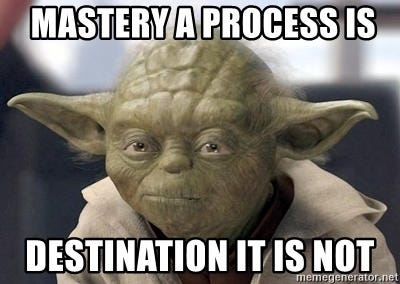
Yoda
Mastery is a strange concept. It’s something we always strive for, but not everyone has the same definition. Even within the same field, people may see some as masters and others may see those same people as still learning. Ego comes into play a lot too. Almost like mastery is similar to perfection in that both are impossible.
Speaking of perfection, I believe that’s where some conflicts come into play. Many believe that to be a master, you need to have perfected your craft. There is nothing else to learn since you know it all. I’ve found that this comes primarily from those outside of the field in question or just starting out. For the first group, they sees masters as those who are confident and make whatever it is seem easy. For the second group, it’s not knowing the details of the path and seeing those far ahead as achieving perfection. Once you catch up, you’ll see that mastery still has space for learning and mistakes.
With perfection not being the goal, one could fear that mastery is a bigger struggle than we think. How can we know we’ve become masters if we aren’t perfect? Can’t believe our supporters since they might just be trying to keep our spirits up. Can’t believe ourselves since we might be suffering from inflated egos. Especially in the arts, there are no solid metrics to tell when you can start calling yourself a master. That might be the whole trick to it too.
Perhaps a real master is one that doesn’t realize or accept that they are one. They possess the skills to excel in their field, but are always evolving and changing. Mistakes still happen and they grow from those experiences. Due to always trying to improve, this person retains a level of humility that prevents them from announcing or acting like they are masters. They still give advice and help others, but are quick to ask for the same when they have doubts. Yes, mastery shouldn’t mean that one lacks all doubts since that’s our mind saying we might be making an oopsie.
All of this makes me feel like my own struggle for mastery is simply in my head. At least, it isn’t really about mastery. Accepting that I need to always improve, my struggle is to gain the level of skill to reduce my doubts and increase my confidence. Not eliminate my doubts completely, but to be able to keep them in check enough to make them work for me. As far as the skills, the mastery of those is to always remember that there may be something to learn in the future. To never settle for what I am now and to grow in order to nurture my stories or whatever I am working in. Sounds oddly poetic, but I’m having trouble putting it into exact words.
So, what do other people think of mastery and the struggle for it?





 Legends of Windemere
A very thought-provoking topic. I can’t help thinking of Avatar: The Last Airbender, particularly the air benders, who gave tattoos to masters. That way, everyone could see at a glance that this person was a master. Sometimes I wish we had something like that. 😊 I also think about the Kung Fu Panda movies and how masters still wanted to learn. But I think you’re right in that those who probably are masters don’t often think of themselves in that way, because they still desire to learn. So many times in shows and movies, we see characters who instantly attain mastery of a skill, seemingly without difficulty. This makes sense in our instant-gratification culture where waiting five minutes for something seems “unreasonable.”
LikeLike
The instant master thing irks me a lot. Mostly when it’s happening across multiple skills.
LikeLiked by 2 people
So right. We never “master” a skill flawlessly, but we should always seek to improve our skills. That said, it’s important to listen to feedback of all sorts. So when we’re struggling for perfection and someone has a critique (assuming it’s honest and not spiteful) it’s good to say “I’m still learning.” What’s sometimes harder is if we get a compliment we should accept it and not minimize it because “I’m still learning.” Take the props when you can get them!
LikeLiked by 1 person
Really is tough to take the compliments. Is that part of the imposter syndrome effect?
LikeLiked by 1 person
You can tell a master by asking the question, “Are you a master?” A master would have a tough time answering that question given the knowledge of what more needs to be accomplished.
LikeLiked by 1 person
True. That or they’ll say no. Hard to tell.
LikeLiked by 1 person
The greatest snooker player of all time, Ronnie O’Sullivan, claims he still has things to learn. He still practices to improve.
I don’t think there is anyone who has mastered everything in their chosen craft. That doesn’t mean there are no masters, though.
In the past, a person would complete a piece, called a masterpiece, and if their teacher thought it was of a high enough standard, they would become a master. But that’s just a title to say they have reached a certain degree of proficiency.
LikeLike
Maybe we should go back to the old ways. Do something great to earn ‘master’ as a title. Sounds better than it being used to casually.
LikeLiked by 1 person
I love your little debate. Maybe mastery is in the eye of the beholder. They see someone as a master, but that person doesn’t feel the same way. I liked it when Anakin was denied the title of master, because he hadn’t earned it.
LikeLike
The Anakin thing is a good example. He did seem to have the power of a master. Yet he lacked the discipline. Maybe a part of mastery is behavior instead of simply skills and knowledge.
LikeLiked by 1 person
As a teacher, I am realizing more and more as each year passes that there is no such thing as mastering the art of teaching. Sure, I feel more confident in my abilities, I can anticipate situations better as a result of experience, and have streamlined some of the processes I need to do such as writing report cards or assessing essays. However, there is always more to do, more to learn, ideas to integrate, paradigms that shift. And I love it. How boring the job would be if I had “perfected” it and had nothing left to learn.
LikeLike
Feels like the system keeps changing too. Maybe that’s why they have educators do professional development so often.
LikeLike
It’s a sort of Zen riddle, I think: perfection is a state we should strive for, with the understanding it will never be achieved. And we wouldn’t even want it to be. Perfection is the enemy of art. As such, it can only ever be a process. I teach writing and rhetoric, and it’s so limiting to students when they think of their work as “product.” Because the product is something static. But when they learn the process of creation, they learn to develop their own ideas and practice perfection
LikeLiked by 1 person
I really like the ‘perfection is the enemy of art’ idea. Never heard of it before, but it makes sense. An artist always wants to improve and tends to be their worst critic. If one deems a work perfect then they probably aren’t looking at it hard enough. How do you get your students to see their works as fluid instead of static?
LikeLike
Thanks – that line is one I throw at my students (and myself) a lot. I think it’s mine? But if it’s actually Proust, or Max Headroom, or someone the theft is unintentional.
And getting students to see work as fluid is a huge challenge. The students know the game to well and they’ve learned that it’s about the product, the finish line. But I at least try to make their works come back again and again to practice revising specific parts, or reiterating it for a new audience, or in a new genre or mode; things like that. It is, ironically, an ongoing, imperfect process!
LikeLike
Unfortunately education does seem product-based. Defined results are more important than the path.
LikeLiked by 1 person
Pingback: 📰The Struggle for Mastery — Bernard Aybout's Blog - MiltonMarketing.com