
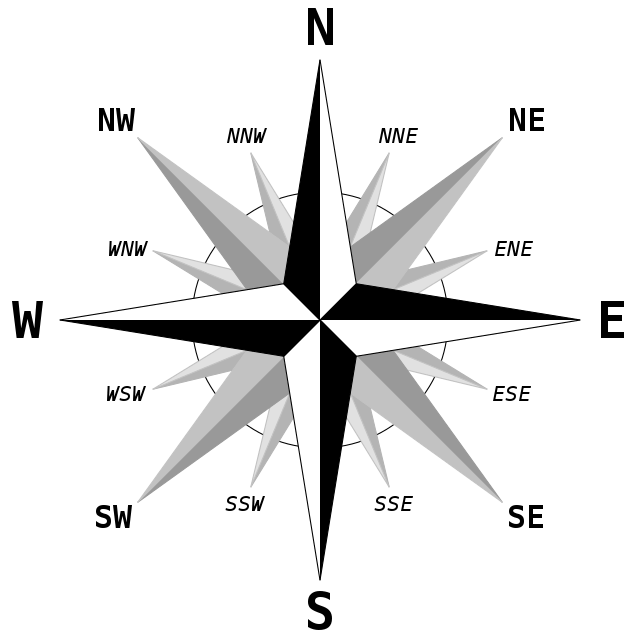
Cardinal Directions
Come to think of it, do people still care about the cardinal directions? I remember being taught by my dad how to find north, south, east, and west. It never stuck since I was supposed to use the sun. I ended up figuring it out by remembering where the local parkways go in conjunction with my location. As long as I can picture the nearest highway, I can figure it out. Don’t think they have this advantage in fantasy worlds and I’ve probably undermined the original intent of this post.
Using the cardinal signs for more than directions has been a big thing in fiction. I believe this stems from mythologies doing the same thing. For example, Greeks and Romans had a god for each of the four winds. Ancient Egypt had the four sons of Horus and positioning of bodies. The list can keep going, but it seems using at least the four major directions has always been important. Kind of funny considering this appeared in cultures across the world without contact. Not that they called the directions the same thing, but it was similar on some level. Makes me think that part of human nature is knowing where we physically are in relation to the rest of the world.
You might be wondering why I’m bringing this up on a fantasy writing blog. Well, the cardinal directions are very popular in fantasy themes. They’re an easy-to-use group of four that can be utilized for monsters, kingdoms, oceans, and whatever else you want to create. Need to make a variety of elves? Have each one come from a different direction and associate specific weather patterns/environments with them. That’s just one example of what you can do with cardinal directions. You can branch it out to 8 as well if you include the diagonals. There are the other ones too, but I never understood the 3 letter ones very well.
Early on, I used a compass for my fantasy world, which was called Mylrix. There was a continent in ‘each direction’ and a central collection of islands. This became Windemere prior to the Great Cataclysm, which I still need to figure out. The problem with doing this with landmasses is that you’re working with a globe. As a teenager, I didn’t think about this when I made my map and still haven’t figure out how to make this work. Right now, it’s looking like I’ll jettison the whole concept and have the continents located in approximately the same area. Really makes one realize how much ocean is on a planet, but I don’t think Windemere is as big as Earth.
My favorite thing with cardinal directions is when they’re used for symbolic creatures and systems. I’ll get more into these on Tuesday, but the general idea is that each direction has an associated ‘thing’. It’s so simplistic in its creation, so it works when you want the audience to catch on quickly. There’s so much you can do with this and everyone will understand it on some level. Even if the words are different, most places have the cardinal directions. There is something equivalent to north, south, east, and west as long as you’re on a planet. Outer space and similar regions might be the exception, but then you kind of get up, down, left, right, forward, and back. Not sure if that’s an equivalent, but it can be worked with. Like I said, there is a great amount of versatility in the cardinal directions’ simplicity.




 Legends of Windemere
This is going to be a fun collection of posts. I was a surveyor and mapmaker in a previous century, so I’m interested in what you have for us.
LikeLiked by 2 people
Hope they meet your expectations. It was a tough one to tackle because it felt both simple and complicated at the same time.
LikeLiked by 1 person
Interesting post, Charles!
LikeLiked by 1 person
Thanks.
LikeLike
I would say our ancient ancestors had a definite need to know where they were. It helped them find resources in season, follow herds, and so on. That still comes down to us, even now that we have good maps and GPS. (For one thing, it might help us know when not to listen to the GPS.)
The compass rose is certainly an easy framework to begin planning your world. It’s something people already know, so you can get on with the rest of the story.
LikeLiked by 1 person
True with the ancestors. Though I wonder if it was as detailed as we think. Just like any animal, they could have just headed in the direction where they saw food and warmth.
LikeLiked by 1 person
Using the Native Americans as an example, they may not even have needed a compass or anything to guide by because they knew their landscape so completely and they knew the seasons of the resources so well that they could be where they needed to be.
People like the Vikings who traveled the open seas would definitely have needed the guidance though.
LikeLike
Ocean travel definitely requires more tools. Lack of landmarks will always pose a problem.
LikeLiked by 1 person
What a great post!!! Wow! Great info on cardinal directions. I wish I’d used them more thematically as you mentioned here. I mostly used them to orient myself as I wrote the story and made the maps for the book. I used the usual north, south, east, and west.
LikeLike
I don’t use them enough in my stories either. Just never thought about them until now.
LikeLiked by 1 person
In my upcoming children’s series my MC does a ritual to summon the Elementals – Gnomes (earth) in the north, Sylphs (air) in the east, Salamanders (fire) in the south and Undines (water) in the west – so he needs to be sure of the cardinal directions!
LikeLiked by 1 person
Cool. Always an important system in fantasy.
LikeLiked by 1 person
I find the most important consideration re: Cardinal (or other) directions that often gets overlooked in fantasy worldbuilding is the baseline reference point. Our maps define direction broadly on the magnetic poles and direction of the sun’s travel through the sky (modern at least – medieval maps could be wildly different in interesting ways). But that doesn’t have to hold true for any given fantasy world.
With your example of Mylrix, it may make perfect sense for the world to be defined as centered around the archipelago, with continents in each of the cardinal directions – at least, to a resident of the archipelago, it does. But to the people of, say, the western continent, maybe the world revolves around the volcano at the center of their continent, and east/west are defined by the prevailing winds that blow in off the ocean like our world’s North-Atlantic Jetstream.
Maybe the ‘north’ and ‘south’ continents are actually separated by only a very narrow channel sea, directly opposite the globe from the “central” archipelago, so while the islanders think of them as being in diametrically opposed directions, the northers and southerners recognize each other as close neighbors instead.
That’s my two cents at least: perspective is everything.
Anyway, thanks for sharing, Charles! I appreciate the various insights and tips/tricks here on the SE blog.
LikeLike
That’s definitely an issue. Though it also makes me wonder about our real world. What if there was a group that decided to not use the poles and sun as the definitions? Not really a way to stop them even though it wouldn’t match the rest of the world. As long as it makes sense to them, which isn’t the best reasoning. This makes me think how we have metric and imperial measuring systems.
I think any world with a sun and realistic planet movements would be likely to use that system. At least that’s my opinion.
LikeLiked by 1 person
The sun (and/or stars) is absolutely a strong reference point, and I’m inclined to agree that most cultures are likely to use it in at least some baseline manner. The only real-world example to the contrary I’ve found (with an admittedly cursory search) is possibly the Hawaiian “Mauka” (toward the mountains) and “Makai” (toward the ocean), but I can’t find any documentation at present suggesting how the sun may have interacted with these directions. I am NOT about to claim any expert knowledge on Hawaiian culture or tradition, but in a fantasy setting, I could see the logic of a small island nation giving more cultural importance to the center of their island/the world and what direction the storms (or tsunami) come from, than to the path of the sun across the sky.
My other thought-experiment question though is this:
Why does the sun need to rise from the right side of the map, and set on the left?
The BBC has a great article on just this question throughout history:
https://www.bbc.com/future/article/20160614-maps-have-north-at-the-top-but-it-couldve-been-different
A few basic takeaways being: Christian maps often put East “up” because that was broadly toward Jerusalem; Islamic maps often put South “up” because that was broadly toward Mecca; Chinese maps put North “up” because that’s where the emperor lived.
While all these cultures/nations certainly used the sun for direction and navigation, it still wasn’t culturally important enough to define the orientation of their maps.
Sorry if I’m going a bit long-winded here… I just really love this aspect of worldbuilding 🙂
LikeLike
All I could find on the Sun and Hawaiian cultures was that it’s importance was in regards to agriculture. Although, Polynesian cultures did supposedly use astronomical navigation using stars and the Sun. Don’t know if that had cardinal directions.
Small islands where the locals don’t leave would have a more personal direction system. I can’t see any reason they would need more if they aren’t leaving the area. Just like today, a person will utilize landmarks more than cardinal directions when traveling locally.
Doesn’t look like the sun rising from the left would make any difference. As long as it’s not a sudden change, which would cause the planet to stop just long enough for everything to die.
The map situation is interesting. Ancient cultures seem to have had different maps that had their area in the center, so the directions would look different. Can’t find a clear origin of the words though. Finding evidence of them coming from Germanic, Latin, Greek, and even Native American. Just a hodgepodge of influences.
LikeLiked by 1 person
I have not thought about Cardinal Symbols in stories. I am looking forward to more.
LikeLike
Thanks. Enjoy the posts.
LikeLiked by 1 person
Thanks
LikeLike
Space is a tricky one, Charles. There isn’t really an up or down any more than there is a north south etc.
An interesting post. Looking forward to the next one.
LikeLiked by 1 person
Thanks.
LikeLike