
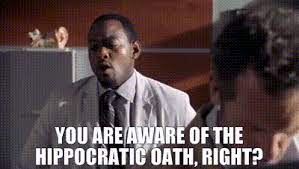
First, it’s difficult to even figure out what the Hippocratic oath really is. We tend to think immediately of doctors swearing to do no harm to their patients. Yet, something like this doesn’t appear until the second to last paragraph of the original oath. Prior to that was treating your teacher like family (including giving them money) and a list of things you cannot do like removing kidney stones or administering poison. The paragraph we think of mostly is translated to:
“Into whatsoever houses I enter, I will enter to help the sick, and I will abstain from all intentional wrong-doing and harm, especially from abusing the bodies of man or woman, bond or free. And whatsoever I shall see or hear in the course of my profession, as well as outside my profession in my intercourse with men, if it be what should not be published abroad, I will never divulge, holding such things to be holy secrets.”
Let’s work off that for the rest of this post.
One could argue that this should be common sense for a healer. Their career is to take care of the sick and injured, so why would the want to harm others? Why would they even need an oath? I could ask why our modern medical system needs it, but that’s a different and messy conversation. It still can have you scratching your head about why this kind of thing is necessary.
In terms of fantasy healers, they tend to be priests who get healing magic from deities or have been taught medicine in their church. You also have healers that use items from nature like herbalists and what we may think of when we hear Pagan healers. They can even get their information and supplies from spirits. Going back to the first example, you do have an ‘oath’ made to their god to follow the edicts in order to keep getting the power to heal. So, it isn’t a Hippocratic oath, but a pledge of loyalty to whoever their magical benefactor is. Guess breaking that would be the fantasy equivalent of malpractice, but that’s a stretch.
Maybe this is overall nitpicking. You only see the Hippocratic Oath come up in medical dramas or when an author is trying to put a healing character in a bind. We overlook it when writing so much because our fictional doctors are designed to operate regardless of its existence. If they’re good and honest then it will never come up. If they’re bad then they won’t care in the least. The Hippocratic Oath turns up when a good doctor is on the verge of falling or a bad one is going to get their comeuppance. It’s nothing more than a tool that we barely analyze and don’t have to because your average reader only knows ‘do no harm’.
In general, I think the Hippocratic oath demonstrates an interesting mental habit. We take a lot of things for granted in our world. Things we don’t question because they operate behind the scenes or don’t overtly affect us. Society simply functions this way and we carry this into our fictional worlds. If it isn’t something we’re directly trying to alter, we leave it alone. Economies exist unless we want to go with bartering. Everyone speaks whatever language we do because that’s what we write in. Farming is a thing without any core differences than what we do in the real world. Doctors are focused on healing and helping others unless they or another entity is evilly influencing the system. These things are just there unless we don’t want them to be.
So, what do you think of the Hippocratic oath and similar real world ideas turning up in fiction? Especially non-Earth fiction.




 Legends of Windemere
This is a fascinating question.
LikeLiked by 1 person
Thanks. 😊
LikeLike
Good point about the Hippocratic oath. Perhaps authors are basing the healers’ actions based on the oath or on a moral code. I’m used to stories by authors like Robin McKinley, who wrote two books of fantasy short stories. She usually wrote about the local wise woman who used herbs to heal others. They were also midwives. Some feared them and called them witches. Robin never referred to them as such. But they healed people in need—whether enemies or not. In em> Avatar: The Last Airbender, Katara healed people using spirit water. She felt she needed to help people, even people from the enemy nation, no matter what, though her brother Sokka disagreed with her at times.
LikeLiked by 1 person
I remember reading that the fear of medicine women was common in history. So, I can see where that comes from. Maybe authors are so used to doctors following the oath that they figure it’s the norm.
LikeLiked by 2 people
Avatar: The Last Airbender,
LikeLike
Charles, I don’t know about non-Earth fiction, but I address the Hippocratic Oath (real world) in my historical fiction sequel. Do no harm, heal the sick body or mind. And vulnerability of the patient enters the picture. The main character, a nurse, discusses this with her physician husband. And she comes up with a reasonable decision for her actions; how and why she treats a particular patient, a prostitute, and Communist informant (the catalyst). 📚🎶 Christine
LikeLike
Make sense for real world fiction having it. I probably should have said fantasy in the title. Oops.
LikeLiked by 1 person
I think having an oath is an excellent way to direct the reader back to the principles of the folks doing either medical or magic stuff. It can be used to bring a character into control.
LikeLike
True. Though, it does bring up the question on if it would be the same path we have in reality.
LikeLiked by 1 person
True
LikeLike
It seems to me that this oath must have originated from a lot of hard experiences. The things they mention, like not poisoning people, imply that physicians were being asked to poison people at some point in time. Stating that you won’t hurt people “either bond or free” (ie: slaves) suggests that people tried to say it was bad to hurt free people, but hurting slaves would be okay.
Looking at the history of modern medicine, this was definitely a real thing. One doctor did hundreds of surgeries on slave women, without any medication. Another group did their notorious syphilis research on formerly enslaved men.
In fantasy, the potential for healers’ skills to be abused is pretty clear. Depending on how dark you want to get, a healer could be paid or threatened into poisoning someone, or giving them “medicine” that didn’t work, or told they could do cruel experiments and it would be okay as long as it was on animals and not people. For healers with a conscience, having a god’s power or other oath to support their ethics might be really important.
LikeLiked by 1 person
All I could find is that Hippocrates considered healing a scientific art. So, he felt standards were needed like with other practices. With the slaves part, I think about how you occasionally see news articles about doctors refusing to treat certain groups. Medical bias has probably been around since the field’s inception.
LikeLiked by 1 person
Interesting. Actually, I had my elf priestess and her fellow novices swear an oath in Dreams of an Elf Maid. It was important because it brought her into conflict with her seniors.
LikeLiked by 1 person
The seniors didn’t believe in a healing oath?
LikeLiked by 1 person
It’s a bit more complicated. The Most High, the highest cleric, governing all the various churches, had vowed to eliminate evil from the world. On the face of it, a laudable thing. But there is the danger of unforseen consequences. One of these was that in order to eliminate evil, evil people must go, too. So healing was withheld from those perceived to be evil. Asphodel got into trouble for healing the son of one of these people.
She is always in trouble for standing up for what she believes to be right.
LikeLiked by 1 person
Sounds like trouble. Always thought it was interesting when a person setting out to destroy evil can turn evil.
LikeLiked by 1 person
I think it’s one tool in the box. It will go unused until something comes up where it could add tension or advance the plot. As far as SFF, it should have some ramifications if used. Breaking this oath could come with consequences from the gods or something.
LikeLiked by 1 person
True. Fantasy and science fiction could make it more severe. There might be a good story in that.
LikeLiked by 1 person