
Google Image Search
Here we are at the final category of advice that I’ve devised to make this theme last no longer than a week. Yeah, I’m sure I could have kept this going through the summer, but that’s way too boring. Do I Need to Use a Dragon? needs good promos, especially since it’s still 99 cents on Amazon Kindle. There we go. Let’s proceed.
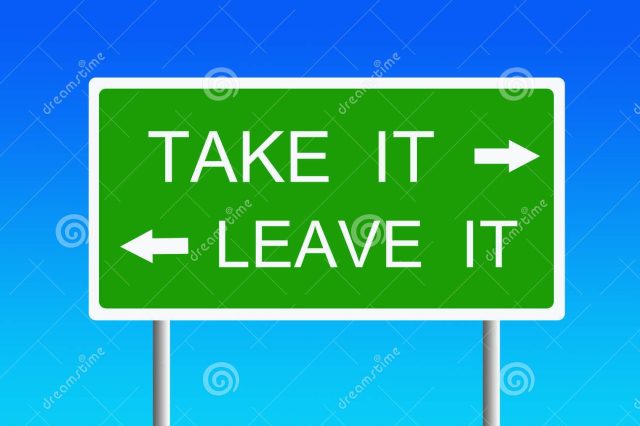
‘Eh, Take It or Leave It.”
You can feel that apathy coming off those words. At least, that’s how I see it. You can hear this used as an ultimatum, but that doesn’t make sense to me when it comes to advice. I mean, you aren’t physically leaving the advice behind. You’re just not listening to it if you decide it isn’t for you. This isn’t a used toaster in a discount bin that we’re talking about here. You’re not paying for the advice . . . Unless you’re spending 99 cents to get a copy of Do I Need to Use a Dragon? I couldn’t resist that plug.
A person who gives advice like this might feel obligated to share their knowledge, but not emotionally invested in the exchange. They feel the trick might work, but know that it isn’t for everyone. It’s similar to ‘It worked for me’ in that there as an acceptance that the other author might not succeed. The two categories give the receiver the choice of following or not with very little or absolutely no pushing. So, it can be easy to think that they are one and the same.
The difference in my mind is how the giver’s stance on the outcome. ‘It worked for me’ has hope that it will hope, but it is giving caution that it won’t. This time, there isn’t much concern on if it works or not. As I said, there’s an odd sense of obligation in giving the advice. Almost like doing so is a chore and they are getting it out of the way. You see this in open discussions that go on for a long time, so there could be a push to simply end the conversation. Personally, I’m always caught off-guard when a person gives me advice in this method because it makes me feel like I made them mad.
How can an author get to this point? From those I’ve run into, it’s because they’ve had bad experiences giving advice. Either what they suggested failed and they were blamed or they’ve tried multiple things that didn’t work. A long run of failures and disasters will turn a person off to giving or receiving advice. Yet, there’s a spark of wanting to help still burning and that’s why one might still offer an opinion. That or they are put in a social situation where saying nothing can be mistaken for rudeness. Humans do a lot of awkward things to avoid being seen as a social misfit.
I find this the hardest category to wrap my head around because it stems from a total lack or restraint of passion. Authors tend to be excited about their trade, so they are happy to talk shop. This inevitably turns into swapping tips or explaining methods, which is giving advice. Doing so without being even remotely excited is difficult to understand, but that might just be me. This is why I lean towards the person being passionate about their writing, but not about giving advice. Makes sense since not everyone who loves doing something is interested in teaching about it.
To my knowledge, I didn’t do any ‘take it or leave it’ advice in Do I Need to Use a Dragon? I did my best to keep it in the second category. I want people to accept my advice, but also to know that it isn’t a guarantee. I understand if people want to skip or alter the tips that I suggest. We shouldn’t be forced to accept all advice given to us. I did that once and it took me 2 years to repair the book that was the victim of my naivete. So, I definitely talk from experience here.




 Legends of Windemere
I would probably leave advice that’s half-hearted. Advice like that doesn’t seem tested. Unlike the advice I mentioned from my advisor who told me to ignore any advice that doesn’t cause you to feel excited about working on your story. She knew what that felt like. I also know what it feels like, having abandoned stories because of advice that caused me to hate them.
LikeLiked by 1 person
I can see that. Advice given this way really doesn’t come with confidence. Although, I have met people who do it this way because of a history of being ignored.
LikeLiked by 1 person
I can understand that. If someone asks for advice, and then proceeds to either ignore it or trash it (telling you what aspects of the advice don’t work, in their opinion), I would be reluctant to offer advice in the future.
LikeLike
I agree.
LikeLike
I agree with you, Charles. It’s not an approach I would take. If I didn’t believe in my own advice, I probably wouldn’t be giving it.
LikeLiked by 1 person
Same here. I do remember a few authors do this when asked for advice too. Maybe it was just to get people to leave them alone.
LikeLiked by 1 person
Could be a way to end the conversation if things were getting tense?
LikeLike
I think that some people who give advice expect it to be taken. One person in a critique group I’m in told me that she noticed I’d not used any of her suggestions, so she wasn’t going to critique any more of my work.
LikeLike
There are definitely people like that. I usually put them in the ‘this advice is gold’ category. Though I can see how they’d turn up here out of wounded pride.
LikeLike
Advice is always tricky. Particularly in blogs and books, because nobody asked for it. At least a few searched for something, and that gets part way there. Honestly, we can’t listen to everyone. Some advice is in conflict with other advice. Sometimes a tip that worked in one MS refuses to work for the next one. It takes a bit of mileage to figure some of that out.
LikeLike
I find it a little easier in blogs and books than verbal. When it’s told to your face without asking, it’s harder to ignore.
LikeLiked by 1 person