
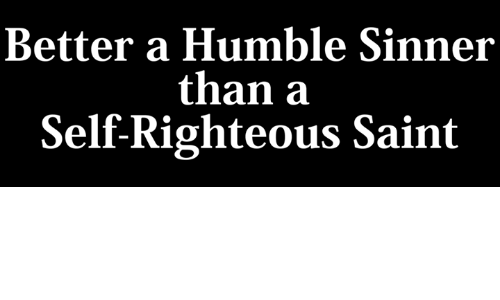
This is going to be another post that depends heavily on personal limits, standards, and perceptions. A person may be self-righteous to one group while totally acceptable by another. So, I’m going to try to avoid specifics here. It’ll be a general overview of the character throughout the week. Now, what is this type?
These are characters that act morally superior to others whether their ideals are unfounded or not. They can be very judgmental, egotistical, and occasionally narcissistic towards the rest of the cast. Many times, you will find this associated with religious paths, but that’s basically low-hanging fruit. Nobility too. The truth is that anyone can be used as a self-righteous character if they are written that way. For example, a character who grew up poor can act this way because they feel they have suffered so much that their world view is the only true one. People might have more sympathy for them or agree with them, but the self-righteousness is there.
As you can see, this is typically defined as a ‘negative’ trait because it’s demonstrated with a high level of smugness. They don’t listen to opposing views or change their opinions unless they are rocked entirely to the core. Most times, an author will have these characters either break, grow through great suffering, or turn traitor. This sounds like what you can do with any character, but the difference here is that nearly everything revolves around this self-righteous path. If you write one with it at a low level then you can develop a different arc, but this attitude taking up the forefront is something that needs to be handled. A lesser version could be them targeting one specific character as inferior and developing the friendship instead of having them anger everyone.
Within the group dynamic, these characters cause tension and it can be a challenge to make them gel. This isn’t necessarily a bad thing because it can help everyone grow, but readers are quick to turn off to the self-righteous figures. We don’t like being judged and have a limit on how much we can view others being judged. Oddest thing is that people are able to do the deed more often than they view it or are subjected to it. This makes me wonder if we turn on these characters so quickly because we either see ourselves or recognize a negative force in our lives when they act out. It’s a psychological layer that makes the use of such a character even more difficult.
Personally, I get annoyed by the self-righteous characters. They push my buttons far too quickly, so I have a hard time writing them. My instinct is to make them suffer and shed this trait soon after they appear. This ruins the characters and can jeopardize the entire story, so I only use them when I know they will work.
So, what do you think of this character? How about in real life?




 Legends of Windemere
I like the idea of this character. Don’t think I’ve particularly written one before. They could almost substitute for the true antagonist in a trilogy setting. That probably means a turncoat of some kind, but it can work. Get through book one, then he joins the crew to face the true evil. This character has a lot of potential, because there is automatically tension. Reminds me of all those mean girl characters to a degree, but not quite.
LikeLiked by 1 person
They are a big source of tension. I don’t know if they always fit as a true antagonist. More of a difficult ally in my mind.
LikeLiked by 2 people
I can see that, but it might work as the early problem who then becomes an ally. I need to think this character over. I could have use for one.
LikeLiked by 1 person
It probably depends on if they’re in the group of heroes or not. It can go either way.
LikeLiked by 2 people
Well, I know this character personally as we were married, and he has never changed one bit. My chief antagonist in Angel book is this character, and he only gets worse in time. That is my only book with this type of character. Aside from that, this type of character/person would work in certain fantasy genres that are so adaptable to most anything in a fantasy setting that could turn on the character. Example: Look at the character of “Regina” in the TV series “Once Upon A Time”. She went from pure evil, hate and being narcissistic to learning how to really love and care for others, not just herself, but for all the people in all the different realms.
LikeLiked by 1 person
Good point. I never really saw Regina as self-righteous, but she definitely meets some of the requirements. It kind of shows how the type is quick to make themselves out to be the victim too.
LikeLiked by 1 person
Aside from my ex, Regina came to mind just like that. It fits her. Thanks. Regina made herself a victim of her own mother, then used that as her way of doing the evils she did.
LikeLike
I think it was Jung who observed that the things that bother us in others are the same things we don’t wish to admit we, too, do. In that light, it’s no wonder we have little time for self-centered or self-righteous people 🙂
LikeLike
I don’t quite follow. Do you mean we get impatient with these types because all of us are self-righteous?
LikeLiked by 1 person
In a sense. We all have aspects we dislike in ourselves; what Jung called the Shadow self. Since we go through the trouble of fighting them, we get annoyed when others fail to do so.
LikeLike
If we’re even aware of the traits in ourselves.
LikeLiked by 1 person
In the Legend of Korra series, some of the villains were the self-righteous type. And in the Cadfael mystery series (written by Ellis Peters and adapted for ITV (starring Derek Jacobi), Cadfael’s nemesis is a self-righteous monk named Brother Jerome. I’m working on a character who is like Brother Jerome. These characters are good for testing the resolve of the main character. They are irritating but good for conflict.
LikeLiked by 1 person
It’s interesting how everyone is putting this character immediately into the villain category.
LikeLike
I love the Cadfael series. I think Brother Jerome is a good example of someone who is on the same side of the protagonist, but who is an annoying character because he and Cadfael can’t agree on anything. We all have that aggravating family member or co-worker who drives us crazy but who isn’t really bad. A self-righteous character is great for conflict without being a bad guy.
LikeLiked by 1 person
I love that series too, missimontana. And I agree that this character is great for conflict.
LikeLiked by 1 person
We all hate self-righteous people so maybe done right a self-righteous character may be an excellent villain.
LikeLike
They do seem the type according to the comments.
LikeLiked by 1 person
All good thoughts. I could see the party rogue constantly heckling this character, a self-righteous figure screwing up the quest results (maybe through messing up verbal negotiations), or (as you said) being the villain.
LikeLike
Those in the group with minimal tolerance for the type would definitely go after him. To keep them a hero, you would have to make them effective at something though. Hard to keep these characters as heroes.
LikeLiked by 1 person
Agreed.
LikeLike
Reblogged this on Author Don Massenzio and commented:
Check out this great post from Charles Yallowitz’s blog on the topic of The Self-Righteous Character: Earning All the Eye-Rolling!
LikeLike
Thanks for the reblog
LikeLiked by 1 person
You’re welcome.
LikeLike
I like the idea of this type of character as an antagonist. We can pull examples from the news of those that think they are doing all the right things but are, in reality, causing divisiveness and harming others through their righteousness. Great post.
LikeLike
I’m seeing that people prefer them as antagonists. Do you think they can ever be heroes?
LikeLiked by 1 person
Possibly. Jack Ryan in the Tom Clancy novels seems fairly close to this type of character, but not in a destructive way.
LikeLike
I haven’t read those or seen the movies. The trailers made me think he’s arrogant.
LikeLiked by 1 person
In the movies, yes. In the books, not as much.
LikeLike
I think people do view self-righteous people as antagonists, because they are often seen as telling people what to do, how they should be living their lives, etc. Whether it’s an overbearing parent or a prying activist, nobody likes to be told what to do.
LikeLike
There is big level of judgement in them. Not fun to be on the receiving end of that.
LikeLike