
Yahoo Image Search
The last of the senses might be one of the easiest to use, but it depends on your personal opinion. I tend to find sight the sense that I utilize instinctively only because I think about what is in view when opening a scene. Still, touch turns up a lot and it’s entirely possible that you don’t realize it. The only way you can really avoid it is if every character goes through the story with no physical interactions with anything.
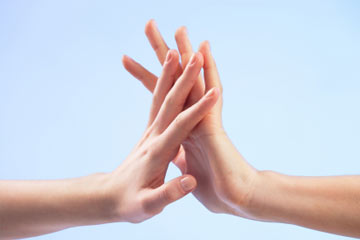
The most obvious use is physical contact between living things or living/inanimate objects. This can ranger from tender touching to friendly handshakes. Kissing, hugs, high fives, and whatever else you can think of involves contact. As the author, you can make note of a texture or condition of the person/object. By doing this, you give your story a tactile element. For example, the young woman felt his rough, battle-hardened hands on her shoulders. Sounds better than ‘she felt his hands on her shoulders’, right?
Something that I include in the ‘touch’ category is changes of pressure, temperature, and other environmental factors. This might be more of a fantasy thing where you can write about the feel of a fireball on an enemy’s skin. Then again, I’ve read Earth-based stories that talk about the feel of the sun’s warmth. My point here is that it doesn’t always have to be something solid against the skin. Pleasure and pain can fall into this category too.
An important part of touch is the reaction of those involved. To give the sense some depth, you need to describe the sensation. A character can run his hands along a new suit of armor, but that’s very basic. Have him describe the smoothness or any imperfections depending on the situation. You can even do it in exposition. Like the other senses, a key component of evoking them in the reader is to have them be a descriptive reaction. How are they to know a the pear that is being picked up is soft or hard without you mentioning it in some way?
Some tips to utilizing touch in writing:
- Most living creatures interact with their environment through touch. From the worm in the soil to the eagle in the skin, their skin feels something. You don’t have to always say what a character feels, but it is a way to demonstrate what condition the environment is in. For example, rain battering their faces.
- Most living creatures use physical contact in social interactions. Think about the situation that they are in and use proper touching/contacts to help pull emotion out of the words. For example, a person putting an arm around a crying friend and feeling their body shuddering with every sob.
- Using touch during dialogues can help build the scene. This shows that the characters aren’t standing still chatting, but moving around and doing things. Think of it as bringing life to a conversation.
- Impacts and reactions to injuries can improve an action scene.





 Legends of Windemere
It is fun trying to come up with different ways to describe the way something feels to the touch 🙂 Love your tips, definitely will be remembering those!
LikeLike
Now that you mention it, finding different ways to write about touch is a lot of fun. 🙂
LikeLike
I love describing the same thing over time. That new armor might have been smooth and cool to the touch at first, but a few battles later it will probably be pitted, rough, and maybe even sharp in some places.
Just like wood can become smooth and worn over time, creating well worn banisters that feel like cashmere under hands.
LikeLike
Degradation of equipment is a must for me in writing. Even if I don’t go too far, it pays to show maintenance on gear as well.
LikeLike
Sari is very physical, so I thought of her as I read this post. Touch is a great sense to use, because so many people talk with their hands or move things around whenever they’re speaking. I do that a lot when I’m on the phone. But I often have to remind myself to let the characters do it too.
LikeLike
She really is and it seems to get ‘worse’ as the series continues. Once she gets comfortable and grows stronger, she gets into a habit of delivering spells with kissing. Only the emotion and relaxation spells, but it gets awkward at times.
LikeLike
Also consider the sense of movement when characters travel. Boats are always moving, while horses and other steeds transmit a lot of information to the rider through the legs and seat.
LikeLike
True. Touch tends to be more than physical contact.
LikeLike