
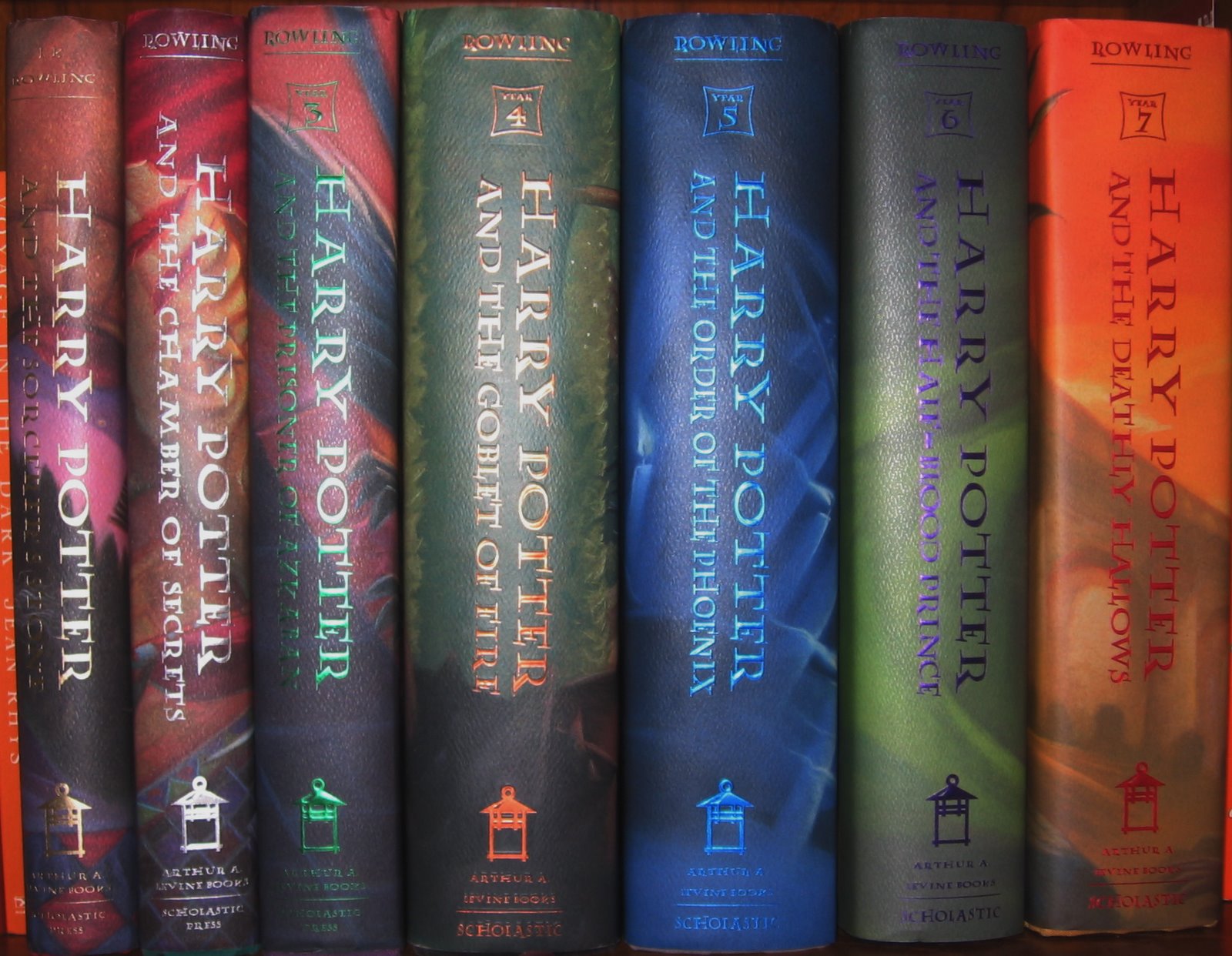
Harry Potter Books . . . Duh.
Did you know that Lord of the Rings: Return of the King is the shortest book of the series? At least it was when I checked my copies today. It looks big because of all the appendices, but it was in the 300’s while Two Towers was in the 400’s and Fellowship of the Ring was in the 500’s. Now, take a look at the Harry Potter series and you’ll see the opposite. I’ve heard that Game of Thrones is pretty hefty too.
It’s interesting how we perceive the length of books. Early on, I had people groaning about at 300 page novel. So far, Beginning of a Hero is the shortest of the series and I haven’t heard complaints about the others. Some people even said they liked the idea of a full-length novel on Kindle. There’s a lot of personal preference to this, so it’s difficult to say what’s too long and too short. If your story remains interesting for a long novel and holds the reader then it’s the right length.
From an author standpoint, I admit to being thrown off when I write a scene that is shorter than I expected. In my first three novels, the chapter section lengths ran from 9-12 pages on average. I had a few 6-7 and 13-14 in there. This is what I was comfortable with as I introduced the characters and world. Hit Family of the Tri-Rune where so much has been established and the page amounts dropped to 8-11. Still meaty and I barely noticed the change until I did an edit. The real shock came from The Compass Key where I was having 4 page sections and things averaged around 5-7 pages. A surprising drop that is holding as I start writing Curse of the Dark Wind. Are the shorter sections badly written? Maybe my writing is tightening up?
I do have a theory on my own series. The first book was introductory and establishing of characters and plots. It has longer sections with more meat to flush out the world. Same thing happened with the second book, but it was a traveling adventure that required more description and time. Third book has clean up duty from events of the previous two. Fourth book is introduction of new characters and cleaning up the final problem before the main plot kicks in. When I got to the fifth book, it was time for a few subplots to come to a head and hit some conclusions. Each of these required different amounts of plotting, description, and attention. Will later books be longer or shorter? It’s going to vary. I don’t appear to be the type of author to have every book be longer than the last. That’s just me.
It’s surprising how much attention we put on the length of a book. I hear people making judgements on this before reading it. The cover art can draw a person in, but the sight of something the size of a phonebook (ask your parents, kids.) terrifies some people. Like it’s such a big commitment and they’re not ready. Notice that this tends to happen with the first book of a series. Nobody stopped at Order of the Phoenix and said ‘I’m emotionally invested, but that book is too big’. So, this is definitely a first book problem.
I like big books as long as they hold my interest. I’ve read a lot of huge books that dragged on for a hundred pages or so. You don’t want there to be a chore in the middle of your book or you’ll lose people. Humor, action, drama, and surprises can really help when you have a long work on your hands. Make the reader think there’s a surprise around every corner and they’ll blow through the low energy parts in anticipation of the next shock to their system.



 Legends of Windemere
How many words do your books usually average, out of curiosity?
LikeLike
300-450 pages. The mid-sized book I’ve written so far is nearly 160,000 words. I don’t really pay any attention to word count as much as page count.
LikeLike
I keep track by word count as I don’t wish to write Rowling Size. ARAL will be no more than 110,000.
LikeLike
I never thought of it. I’ve always taken the ‘however long it takes to write a good story’ approach.
LikeLike
More or less, it’s to prevent the work from being chopped by several thousand words for being “too big” for a first. If I do write longer, I don’t see myself passing 160,000.
LikeLike
I do wonder how often that happens in publishing. I’ve rarely heard of it these days, but I’ve been more into the self-publishing for the last year.
LikeLike
It happens now and then. One author cut nearly 20,000 words from his a few years ago. I’m being very careful, trying to minimize the amount of work an in-house editor would need to do.
LikeLike
I had to cut some out of my first book, but a lot of it was word repetition. I’ve been told that it happens a lot in first drafts when one focuses on the story more than the technical side.
LikeLike
It does. Over the years, I’ve somewhat developed a way to focus on story and technicals at the same time. For certain things it works. At other times, not so much.
One of the things I watch for is tied to repetition, called “echo”. That’s when you read aloud and realize a certain sound repeats.There are instances where this works for effect, but it can also be an undesirable thing, being unintended rhyme.
Just yesterday, as example, I had a sentence end with ‘for the XXXX’. The very next paragraph began with ‘For X, narrative here’. The word ‘for’ in this case is the unwanted echo. As this paragraph was introducing an important character, I reworded the end of the sentence prior to the new paragraph to avoid it.
There’s also what I call “echo mimics”. When you have a character whose name is not an every day name, the use of their name can appear to be an echo of sound and repetition when it is not because it is unusual. My world, for example, is forbidden from names like Robert, Alice, Jake, etc because in that world they are severely out of place–even re-spellings of those names are forbidden too, as are alternative, lingual variants as they simply don’t exist there. The main character’s name for ARAL is simple, a two syllable name, but I ran into ‘Echo Mimic Syndrome’ before I became accustomed to the name.
LikeLike
I try not to do that kind of echo, but sometimes the writing runs smoother with it. My issue is using the same word or character name too often in the same paragraph. I’ve developed using secondary ‘names’ for characters to help ease this. Such as going by species, role, or another descriptor.
By forbidden, do you mean illegal in the world or you refuse to use them?
LikeLike
By forbidden, it means under no circumstance can they appear in that world. There’s also a huge list of words that also cannot appear in its narrative.
LikeLike
Do you use replacement words for those?
LikeLike
if there is a lesser used word that means the same, yes. If not, it is an in-world term that is used. Balancing the feel is the trick.
One of the primary categories that require in-world terminology is measurements. All time, weight, distance, and temperature terms are in-world. ARAL presents the best opportunity to introduce that in a way that isn’t bombarding a reader all at once.
LikeLike
That’s a big challenge. I’ve read a few books where the author used created words with difficulty pronunciations and I needed to return to a glossary at the beginning. Too much causes the reader to break focus, which can hamper the story.
LikeLike
Modern game tutorials led to the idea of how to spread out such things.
LikeLike
Hmm I don’t know if I could make a direct correlation to Lord of the Rings with other books as Lord of the Rings was written as one book with six sections… it was the publisher who decided to split it into three. (Tolkien never liked the name Return of the King as it was kind of a spoiler, lol)
LikeLike
Yeah, but it was the best I could come up with that people would understand. Only other example I had is a Spider-Man novel trilogy from the 90’s where the first one is 300+ and the last one is 272.
LikeLike
I have soooo many books on my “to read” list, that I tend to shy away from really long books – unless it is an author or a series that has not disappointed me before. I have read some books that I am confident could have cut out a couple of hundred pages in the middle and not lost a thing. Those books are hard to struggle through.
I find reading on my kindle a bit frustrating because I’m never sure how much further to a stopping point (end of the chapter). The % thing really doesn’t help me as much as page numbers.
LikeLike
It’s really hard to tell sometimes. I’ve read long books that I blow through because they’re interesting and short books that I take weeks to finish. Maybe it’s more about interest and pacing than the actual size. I agree with the percentage thing too. Drive me nuts. Not as much as being told how long it will take to finish reading the chapter. That always makes me feel like I’m being judged.
LikeLike
Tolkien math is so much fun. People so often talk about trilogies. Why? Because the father of modern fantasy, Tolkien, wrote a trilogy. Not quite. That LOTR was a trilogy is a long running myth. It’s actually 5 books in 3 volumes, the third volume holding the fifth book and, like you say, the appendices. Thus, “Return of the King” contains the least amount of text, BUT it contains the longest of the 5 books. Of course, that’s a technicality and people could argue that the “books” were actually “parts,” but the final say goes to Tolkien and he called them “books.” Even Peter Jackson’s movies were presented as a trilogy. Then again, “The Hobbit” was one volume, but it’s multiple movies, but that’s a another story. 🙂
LikeLike
Yeah. As I mentioned to Green Embers, I was leaving that out because most people don’t know or really care about it. Although, I’ve also read that he intended for it to be 1 Volume and paired off with the Silmarillion.
LikeLike
Yeah, you’re right, most people don’t care. 🙂
LikeLike
The length is never right. If you love the book, it’s never long enough, and if you’re not really loving it, it’s too long.
LikeLike
Perfectly said.
LikeLike
I agree with Chris as to the length, but you indirectly touch on something the rise of e-readers has created. Shorter novels. I think this is a good thing — that e-books can be any length. That said, the still needs to be room for big, epic novels as well.
LikeLike
Fully agree. I got into a few debates when I started about e-book length. Many believed it was only good for novellas and short stories, but I see it more as a platform for all lengths. After all, it isn’t the size of the novel that counts, but the content and pretty cover.
LikeLike
I didn’t pay too much attention to the word count of RC&R, but I was paying attention to the page count. Funny though. In eBook it was 290, in my page count on computer it was 326, and in the paperback it is 433 all with a word count of 98000. My chapters though, were long. I only had twenty two.
With this WIP, I am paying more attention to word count, chapter by chapter, as I want a greater number of chapters that are shorter. It seems to be the genre trend. We will just have to see how this turns out in the end. Can the story in my head fit this sort of outline? I dunno. I have never worked with such an outline either.
LikeLike
I do the page count too. I know that in paperback, the manuscript gets condensed for 6×9 novels instead of the 8.5×11 printer paper that Word is looking at. Not sure what to say about the e-book difference though.
Honestly, if it feels like the story has to be longer then that’s probably what it should be. To cut and hamper a story for the sake of page or word count does a disservice to the idea. At least that’s my personal take on it.
LikeLike
I have two reactions when seeing big books. If the book is part of a series that I’ve started and love, I’m thrilled that the book is big because it means I can live in the world that much longer. I’ll even find myself pausing every once and again while reading to see how much of the book is left, because I don’t want it to end and I want to see how much more awesome is to come. Whereas if it’s the first book in a series, or a standalone book, I often find myself putting off reading it because I don’t want to invest that much of my time if the story isn’t good.
LikeLike
Maybe that’s why the later books get larger too. To give more to the reader. I wish I knew of a way to hook people on a big first of a series or a stand alone. Maybe those have slow builds after reviews come out that tell others it’s worth the read.
LikeLike
I almost feel like a good marketing strategy would be to release a short story or novelette that’s kind of the intro sampler to the series. You know, a little self-contained story introducing the main characters and antagonist, and then giving a teaser of the world they’re in. And then the first book would pick up wherever the intro sampler left off.
LikeLike
I’ve seen a lot of authors do that. I thought about it, but I couldn’t find any other cover art and didn’t want to use the one for the real book. What about series done by established authors? For example, you read the first series of R.A. Salvatore and his next series has a large first book. Does this make a difference?
LikeLike
Ahh, interesting! I think that would depend mostly on what I know of the series. Like, I know I love the Xanth series by Piers Anthony, but if his next series were a murder mystery trilogy, I wouldn’t touch that with a ten foot pole regardless of how big the first book is. If the series were in the same genre, though, and sounded interesting … yeah, I’d probably be more inclined to read a big first book if I knew I liked the author.
LikeLike
Good to know. I wonder because at some point, I’m going to have a series that has big books. Each one is a 4 act adventure with tiered villains, massive character development, and grand adventures. New heroes and character deaths in each one. I’m trying to mimic the storytelling style of Final Fantasy games, which feel like they’ll be huge. So, I’m curious if my previous success would be a factor.
LikeLike
I think it kind of has to be a factor. Kind of like with musicians — if you like an album by an artist, you’re more likely to buy their next album when it comes out. Again, books are a much bigger time commitment, so it’s a bit different, but I’m thinking the same principles apply. Goodness knows that if JK Rowling ever starts a new fantasy series, I’d be all over that shizzle.
LikeLike
She has the power to make an automatic success, which I think a lot of authors would kill for. I wonder what she’s going to do next.
LikeLike
Are Harry Potter books very long!? I never noticed.
Yes, a book’s size matters. If the author is aiming for a lengthy book, then he/she must know how to keep the reader interested throughout. The fantasy novels are more successful in doing so because they create a new world, from which the reader just can not escape.
And when it comes to monstrosity, I have abandoned three Stephen King novels in between because I was really fidgety with the tortoise pace of the books.
LikeLike
Horror and suspense require time and patience, so I can see large works being difficult for them. Fantasy does have that advantage of new areas, monsters, and magic to keep things riveting. As for Harry Potter, it’s mostly that they get bigger as they progress.
LikeLike
“From an author standpoint, I admit to being thrown off when I write a scene that is shorter than I expected.” I had to chuckle at this Charles because it’s what I’m finding with my NaNo story… I figured 30 chapters averaging 1500-2000 words, so far I have a few chapters that are closer to the 1000 word mark. anyway I’m a day behind still writing yesterdays chapter so I best get back at ‘er
LikeLike
Yeah. I should get to my writing after losing yesterday. It’s funny how the last scene I wrote was longer than I expected and the one before it was shorter.
LikeLike
I never purchase a book based on the number of pages it contains, it is really all about content. Like you if the book doesn’t keep my interest, I don’t care if it is 100 pages or 1000 pages, I likely won’t finish it. As far as a book series goes, the same holds true, it is all about content.
LikeLike
Yup. That’s really what it has to come down to.
LikeLike
Funnily enough I was reading in my Writing Mag that books are getting bigger on average. Some are saying it’s because of the cost vs free/cheap downloads. Theory being that people want value for money if they fork out for an actual book. It’s an interesting idea.
LikeLike
I can agree with that. Comparing the more current books to my older ones, they’re definitely bigger. I see it a lot in YA books, which I think is a good thing because it helps create stronger readers.
LikeLike
You’ve got some great advice there at the end of your post, Charles. All the great books work that way and you’ve figured it out, too! 😉 Have you ever seen Prison Break? There’s an intangible quality about that show that keeps people glued to the set. Well, I shouldn’t say intangible–more like revealing. Transferring the basic concepts of the Prison Break shows will keep the pages turning. It will only work, though, if there’s a story!
LikeLike
I never saw it, but I really should have. It didn’t catch my interest because I didn’t see how a series could go for very long on the premise of breaking out of jail. Now, I think shows like that depend more on characters and subplots than the big plot.
By the way, congrats on the continued Top 100 rankings of your book. I have to admit that I’m looking at your success as a reason for me to relax about marking my next book at $2.99.
LikeLike
If you can catch the whole first season, it’s a great study in storytelling. I recommend it highly!
Also, thanks for the congrats. Even today, it’s still tracking in the Top 100, which still blows me away. Every day brings a surprise. I have to admit, I do get the “How’s your book doing?” question all the time. And rather than answer it individually, I steer folks to my FB page. It’s easier doing that than telling them the stats directly. I just don’t like the promotions aspect of the whole deal. I’d rather write–but that’s me. Regarding $2.99, it seems to be a sweet spot in pricing. A cup of coffee’s more expensive! lol
LikeLike
The promotion side of things is tiring and tedious, but I guess it’s a necessary part of the job. I’m still struggling with answering that question. Apparently, ‘good’ isn’t acceptable. I try to give a general idea of sale numbers and if I’m ranking to give people the idea that I’m succeeding.
$2.99 is supposed to be a sweet spot. I never thought I could pull it off with my first book, so this is the big test for me.
LikeLike
You have a huge following, a great genre to work with and lots of support. You also have a series, which is great for new readers and veterans alike. I’m sure you’ll do just fine!
LikeLike
Thanks. I have the big cover reveal and blog tour to help too. Hopefully, it being Christmas season is an advantage.
LikeLike
I remember reading Shogun ages ago. It was about one thousand pages. And Robert Jordan’s books are pretty hefty. I like a big book. But I wrote a 438 page book that people complained about due to the size. I said, “Well, the fifth Harry Potter book was 256,000 words. Mine is only 115,000.” That made no difference to the complainers. They like a book to be around 60,000–80,000 words I guess. But a book is just getting started at that length!
LikeLike
I wonder if people really like that length of book. They might realize that they already read books with a higher word count. It’s weird because I had one person tell me that my book was too long. The next day he was talking about how great the Wheel of Time series was. I asked him about the length and he claimed they aren’t really long. People are silly.
LikeLike
The interesting thing about our age, is the urge we have to quantify everything…bigger, smaller more words, less words, more pages plus of course everything else we quantify from super big macs onwards…just a thought that occured to me.
LikeLike
We want our food bigger, our technology smaller, and our social interactions from the safety of our own homes. 🙂
LikeLike
Ah, yes!
LikeLike