
Cardinal Symbols
I mentioned that there have been plenty of uses of the cardinal directions to create fantasy and mythological systems. Sometimes, you even have a 5th direction of ‘center’, which is important when we get to Wu Xing. I wanted to give a list of various cardinal systems that have been created in mythologies. Many authors use these for inspiration even though only stick to the one that is from their own culture.
Four Classical Elements
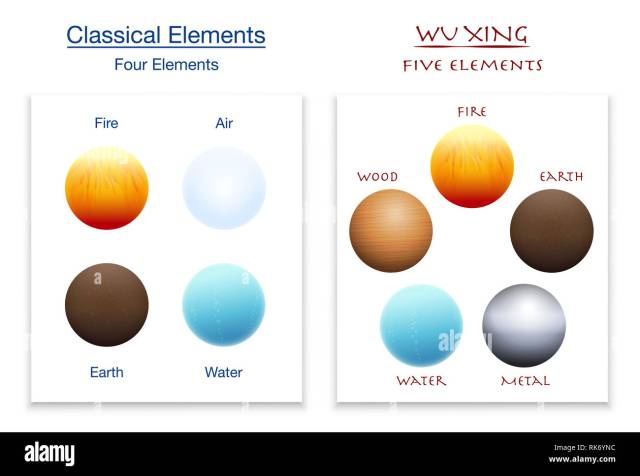
This is very common in Western fiction because it is what we are used to. Earth, Wind, Water, and Fire are the elements that we focus on. They’ve been connected to many fictional stories such as ‘Avatar: The Last Airbender’. Now, authors may mess around with the connections here, but the traditional version is:
- Earth is North
- Air is East
- Fire is South
- Water is West
Authors will occasionally switch things around to make Fire vs Water and Earth vs Air oppositions. This is because the compass is used as compatibility tool.
Wu Xing (Five Elements)
Similar to the four classical elements, Wu Xing comes from China with 5 elements. They also use a 4 element system that ditches Earth, but this is typically done when the beasts are involved. I’ll get to them next. Before you ask, ‘Air’ is not one of the elements for a variety of cultural reasons. This Five Element/Direction system looks like the following:
- Wood is East (One theory is that air is part of life and falls under wood)
- Fire is South
- Metal is West
- Water is North
- Earth is Central
It’s interesting how fire is in the same spot as the previous system. Earth being central makes sense if you think of it more as the planet than dirt. Don’t really know about the others off the top of my head.
Wu Xing Four/Five Auspicious Beasts
These guys get used in anime a lot. I can think of three series right off the bat that used them as either villains, monsters, or plot points. Each of the beasts is a god-like guardian of each direction. They are connected to a direction, color, season, emotion, and many other things. Authors may use them as a simplified Zodiac sign determined by birth season or person’s natural temperament. Either way, a direction tends to be associated with each one.
- Azure Dragon of the East
- Vermillion Bird/Phoenix of the South
- White Tiger of the West
- Black Tortoise of the North
- Yellow Dragon or Qilin in the Center
Japan uses a 4 beast system off this with names too.
- Seiryu the Azure Dragon of the East
- Suzaku the Vermillion Bird of the South
- Byakko the White Tiger of the West
- Genbu the Black Tortoise of the North
Greek Skies and Winds
Greeks actually had two cardinal direction systems. Not sure if Rome copied the one that was about astral phenomenon, so I’m going to leave them out. Does look like they made a 12 cardinal direction system. Anyway, the Greeks had one cardinal system to work off of sky events and another with where winds came from. It was originally only North and South winds, but East and West were added. These systems can be useful if you’re working with a large sailing culture who would be focused a lot on stars and wind.
- Arctos (Ursa Major) and Boreas the North Winds
- Anatole (Dawn) and Eurus the East Winds
- Mesembria (Noon) and Zephyrus the West Winds
- Dysis (Sunset) and Notus the South Winds
This is a simplified version of this. From what I’ve read, more complicated systems were created over time. Homer may have implied that there were 8 wind directions. Aristotle made a 10-12 wind/direction system, which the Romans seem to have copied. This just means authors have a lot to work with if they use Greek mythology and history for inspiration.
Native American
This one is difficult to look into because every tribe had their own symbols. At least from what I can tell. So, take this with a grain of salt because I’m trying to find connecting information. Basically, the four cardinal directions can be connected to the four seasons AND the four stages of life. This can be depicted on what are called medicine wheels in some cultures. Each one has a season, stage, and an animal connected to it. For example:
- North is Winter, Elderly/Death, and the Bear
- East is Spring, Birth/Childhood, and the Eagle
- South is Summer, Youth, and the Wolf
- West is Autumn, Adulthood, and the Buffalo
Now, this can be very problematic if you take it as this across the board. First, not every area in the Americas has the same weather during each season. Summer in Florida is WAY different than summer in Alaska. So, the life stages might differ if you don’t have harsh winters and the summers are the most brutal season. Second, those animals are not found in every region. This is an important note for fantasy worlds too. If an animal does not live within the territory of a culture, why would it be a symbol? It shouldn’t even be known unless talked about by foreigners, which wouldn’t put it on the same spiritual level as the local fauna.
So, those are a handful of cardinal direction systems. There are plenty more out there and much more details for each of these.




 Legends of Windemere
What clever and creative ways of developing these systems in such thematic ways. It inspires me to go the extra mile.
I’m more familiar with the Greek system, since many Western fairy tales and fantasy stories mention the four winds. I’m reminded of a Norwegian fairy tale I particulary love: East of the Sun and West of the Moon.
LikeLiked by 1 person
Greek seems to be one of the more common ones. Although, I think I’d like to try the other systems out at times.
LikeLiked by 2 people
Very fascinating. I’m familiar with some of those. The Japanese one with the four saint beasts had been used in different anime like Yu Yu Hakusho, Fushigi Yugi, and Digimon in the 3rd season.
Another example you can add despite it not being featured as much would be the Congo Cosmogram. It has air for the north, fire for the east, water for the south, and earth for the west. The symbol also has signs for the four stages of existence (conception, birth, maturity, and death) with a cross in the middle diving the physical and spiritual realms and also having the four seasons around in a counterclockwise motion.
LikeLiked by 2 people
I was thinking of YYH when I thought of this. Got Fushigi Yugi on my ‘to watch’ list, but I’m not rushing since I’ve seen it before. ‘The Rising of the Shield Hero’ touches on the four beasts as well. Think there was a ‘Cowboy Bebop’ episode too.
I think Native Americans did the same thing with the compass and four stages of existence. Though, I don’t think they included conception. Do you know why the Congo Cosmogram put the elements in those specific spots? Looks like many cultures put them in different spots. Like somebody mentioned on Monday, it could be geography related.
LikeLiked by 1 person
That makes sense. The timing was interesting since I just read a review of the live action YYH remake that just came out. I haven’t seen Rising of the Shield Hero yet. Yeah, I think Cowboy Bebop used that concept in an episode, but it’s been a long time since I watched it.
Gotcha. I’ll have to research the particular order and I’m curious if it tied into the geography. Since the Cosmogram has existed way before colonization happened, the Kingdom of Kongo was different because it covered what’s now the DRC, Republic of Congo, and Angola. The sun rises in the east which could correlate to fire in the eastern section and the creator god Nzambi Mpungu (side note: Nzambi or Nzambe is used as the name of the Judeo-Christian God in multiple Congolese languages and Mungu refers to the same thing in Swahili in modern times) created existence from fire in the indigenous belief system. That same symbol was even used in some Black churches hundred of years ago including holes aligned to resemble the Cosmogram as breathing space above a hiding spot from slave catchers and the ring shout songs and dances happen in a counterclockwise circle to reflect that direction of that sign correlating to the life stages, seasons, the sun rising and setting.
LikeLike
I saw the live action YYH. Showed it to my son, so now we’re watching the cartoon. The live action was okay for what it was since it was highly condensed. Nothing like the original and definitely more respectful than live action ‘Bebop’.
Yeah. No luck on element placement. Just on the concept of the sun’s passage symbolizing the lifespan of a human. That seems to be common across older cultures, which makes sense. Pretty easy for people to notice the similarities.
LikeLiked by 1 person
I see. The reviewer in question on WP said it was good even if they accelerated through the different storylines. Good to know it was one of the better examples of live action remakes of anime.
Bummer. I haven’t found anything concrete in other places yet. I do have a theory of water being South when you have the Congo River in that region since it’s the 2nd biggest river in Africa, but I could be reaching a bit. That’s not counting the Cosmogram’s Kalûnga River separating the physical and spiritual realms. This also ties to water spirits named Basimbi (plural form of Simbi) that can pass through both worlds. The sun rising and setting could certainly be a common parallel even if other cultures explain it differently.
LikeLike
Live action YYH was also made in China, so I figure they’d be more respectful. Kind of like the Kenshin and FMA movies.
I was wondering about the river too. Also any big mountains for the earth one.
LikeLiked by 1 person
Gotcha. That’s good how they’d be respectful to the source material. I was pleasantly surprised that Robot Communications were involved and they worked on some anime short films I really like such as House of Small Cubes for example which shockingly won an Oscar over a Pixar short that year!
Sure thing. They do have mountains in multiple locations in that part of Africa. Their biggest one is Mt. Ngaliema and I will not call it Mt. Stanley since it’s named after the same Welsh colonist who was an agent for King Leopold II. Anyways, I felt intrigued learning about this symbol even if I didn’t know what it was at first. The first time I remember seeing it was in the La Maison Noir long-form music video by Petite Noir who is a South African musician of Congolese descent and parts of the video reflect the life stages in the Cosmogram.
LikeLike
Pixar isn’t what it used to be. They’ve definitely slacked off over the years, so losing is good for them.
Cool influence on looking up the symbol. Music videos can be great sources of mythological curiosity.
LikeLiked by 1 person
That’s what I heard. I double checked when Robot Communications won and it was in 2008 when they beat out Presto which was the Pixar short that was packed with Wall-E when that debuted.
Absolutely. It was fascinating seeing that music video and how it incorporated the Cosmogram as a recurring image with the sections mentioned in English and Kikongo. Sure, I had ulterior motives watching that music video, but the production, music, and references were on point.
LikeLike
Huh. I’m surprised they beat Pixar during that time period. Wonder what the short was since Wall-E was one of their best.
LikeLiked by 1 person
I never saw that short but it looks like a parlor magic sort of plot and setting. I realized it was when Wall-E came out which I heard was critically acclaimed and some people saying it was one of Pixar’s best movies. It’s even crazy to think that The Criterion Collection got the rights to it not that long ago and Mickey Mouse normally wouldn’t let anyone touch Pixar’s animated canon and certainly not Disney proper.
LikeLike
Amazing stuff. Looks like every culture has its own signs.
LikeLiked by 1 person
True. Gives authors a lot to choose from.
LikeLiked by 2 people
This is good stuff. I hadn’t considered adding any of this to stories, but I can see the value.
LikeLiked by 1 person
Thanks. Glad to provide new info to people.
LikeLiked by 2 people
It’s interesting how some things are in common but others are variable.
LikeLiked by 1 person
Guess it’s human nature like being afraid of pitch darkness and imagining dragons.
LikeLiked by 1 person
Thank you for sharing all this, especially the Asian systems, because I never really gave them much thought, but reading now I understand World of Warcraft’s Pandaria Temple placements much better and its comforting and nice to know that a lot of thought went into the design of the maps.
Much like others mentioned, when writing I tend to stick to Greek methods, I guess because those are the most familiar from the mundane life.
LikeLike
Greco-Roman influence seems to be the biggest in European and Western culture. So, I guess it makes sense that we see those more than Asian. The more recent spread of Asian cultures might be a factor in seeing it more. Heck, I know the stuff through anime I saw back in 1999.
LikeLiked by 1 person
Interesting. I note that there is a plant whose flowers only open in bright sunlight called mesembryanthemum. From Mesembria, presumably.
LikeLike
I’ve heard of that. There are flowers that bloom under moonlight too. World has a lot of interesting flora.
LikeLiked by 1 person
It certainly has.
LikeLike
Pingback: Top 5 of 2024- #1 Various Cardinal Symbol Systems | Legends of Windemere