
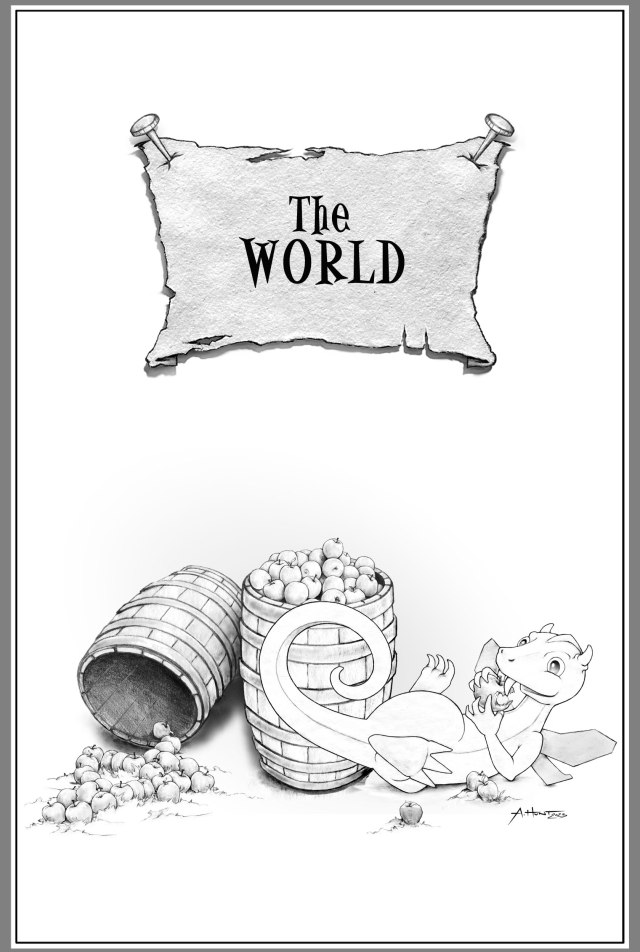
Art by Alison Hunt
World-building has to be one of the toughest parts of writing, especially when you aren’t working on Earth. That’s why Do I Need to Use a Dragon? has a big section on it. As you can see, Fizzle needed to bribed with apples to set still for the picture. So, let’s get to the questions:
- What was the biggest challenge you had with world-building?
- What is a common mistake you see authors do with world-building?
- What is your greatest victory with world-building?




 Legends of Windemere
1. The biggest challenge came with the maps I developed, like figuring out distances and how long it took for the characters to travel back and forth. Also, I didn’t have enough water sources. Had to change the maps again. Then I had to tinker with cities and how they were made and developed over time.
2. It’s hard to say. At a guess, some people concentrate more on gimmicks, trying to make their worlds so unique that they ignore laws like the laws of thermodynamics and instead use magic as a coverall as if magic is inexhaustible. What goes up still comes down!
3. My greatest victory has yet to be seen! No matter how good the world building is, some people will criticize. Look at how people still take issue with Tolkien’s books. He spent many years building his world.
LikeLike
I never mastered map making. Couldn’t maintain a consistent distance key. I gave up and I think most of my maps disappeared with my rpg character sheets.
Time probably does tell what our best world creation is.
LikeLiked by 1 person
1.I tend to go on and on and on into too much detail.
2. Can only speak of this one from a reader’s perspective, and for fantasy worlds: I tend to dislike when the world building of this fantasy world is very obviously based on or equated to something from real life, like for example a different realm has same vegetables as ours and also calls it and grows it and makes same dishes as us humans!
3. A reader saying they felt like they were easily transported there.
LikeLiked by 1 person
I’ll admit to doing #2. I’ve found that using fantasy names for every real world item can turn off some readers. They don’t get the immersion because they’re constantly trying to make sense of things. I remember reading a book that did this and I hated it. Kept having to turn back to a language appendix for explanations.
LikeLiked by 2 people
Yep, it doesnt have to be for like every single thing, but for some big things it can be done more tastefully sometimes like to give an example its better to read and more immersive, at least for me, if it is a human introducing you to these in the book. It is, again for me, a bit eh? when it is for example an elf doing it. I think its about not stacking these builds too much, cause otherwise the world feels just like our world.
I get the conundrum though from both sides, because when I think of examples, I think of LOTR and ‘lembas’. On first sight its easy to grasp, its not regular bread, and if inclined you can dig deep and learn more about it.
LikeLiked by 1 person
LOTR still had regular terms for most things. Legolas still said ‘bow’ for his weapon. Dwarves still talked about gold instead of a different term. I think Tolkien did it right with made up words being rare and used for special objects.
LikeLiked by 3 people
Yeah, I feel like if he did it with absolutely everything it would have not worked so good and it would be overwhelming.
LikeLiked by 1 person
I haven’t done World building but find the answers interesting.
LikeLiked by 1 person
Glad you’re enjoying it. Though, you can still world build in Earth stories. Could be as simple as a fictional store.
LikeLiked by 3 people
Good idea. Thanks, Charles.
LikeLiked by 1 person
I’ve done a little world-building in an earthly spot – and I have a map of the town I created!
LikeLike
Very cool.
LikeLiked by 1 person
1) What was the biggest challenge you had with world-building?
Getting the right balance of information and an intriguing setting, without info-dumping. You also need to be flexible when new ideas appear. Anything that makes your world feel distinct is useful.
2) What is a common mistake you see authors do with world-building?
Just not thinking it through very well. Sometimes the writer has conflicting details, like they live on an island but nobody is eating fish. You can start out with scattered details, but in revision you do have to fill in the gaps.
3) What is your greatest victory with world-building?
No two are exactly alike.
LikeLiked by 1 person
Thinking things through is essential. Although I’ll admit I tend to make that fish mistake. Mostly because I hate eating fish, so it’s a dish that rarely crosses my mind.
LikeLiked by 1 person
I think they’re all challenging and have different demands. My trilogy required me to create more of the world, because the pirates wound up navigating most of it. Some tales stay in the same general location. The space trilogy I’m working on is posing new challenges, similar to Lanternfish, but different. As far as errors, I think just dumping it on the page instead of dribbling it into the story as needed. There are victories here, but those are different, too. Something like Yak Guy was more of a portal fantasy, whereas Grinders was set entirely in a futuristic San Francisco. All of these tales had their fans, and I generally got some nice reviews about the world building.
LikeLiked by 1 person
Good advice on avoiding dumping of info. I’ve only made that work when introducing a new setting and creating the mood.
LikeLiked by 1 person
I thought that if my world was going to be realistic, it would need some history, much like how you need to know your character’s backstory. Most does not appear in the books, but I know it. Also, I researched geology and geography as to where to put my mountains and deserts. It appears deserts are all in a similar latitude around the world. Then there’s making the maps! I hate that part.
A common mistake is to ignore the laws of physics. Fine if you make it clear this world has different laws, but many authors don’t and I find myself saying, “That can’t (or wouldn’t) happen in those circumstances.
I don’t know what my greatest victory is. Probably the history of Vimar, (the world) and Khalram (the continent where the action takes place.)
LikeLike
I used to make big histories beforehand. Then I realized it rarely made it into the books without info dumps. Now I make key points and add whenever I see an opening.
LikeLiked by 1 person
I have a similar problem with names as you do with vegetables. If we are in a fictional world that is obviously not Earth, then it’s unlikely we would get people called Peter or Mandy. I find this really jars.
When I’m writing my own books, though, I agonise over whether to have the characters ride horses rather than make up a different animal. I ended up giving them horses because people know what they are, and I know how they behave. Similarly with meat. When travelling, my characters will catch rabbits and eat mutton in inns. If I had them catch, bremlin, for instance, I would need to tell the readers what they are.
I do occasionally make up a vegetable, though, just to add the feeling that this is a different world
LikeLike