
Yahoo Image Search
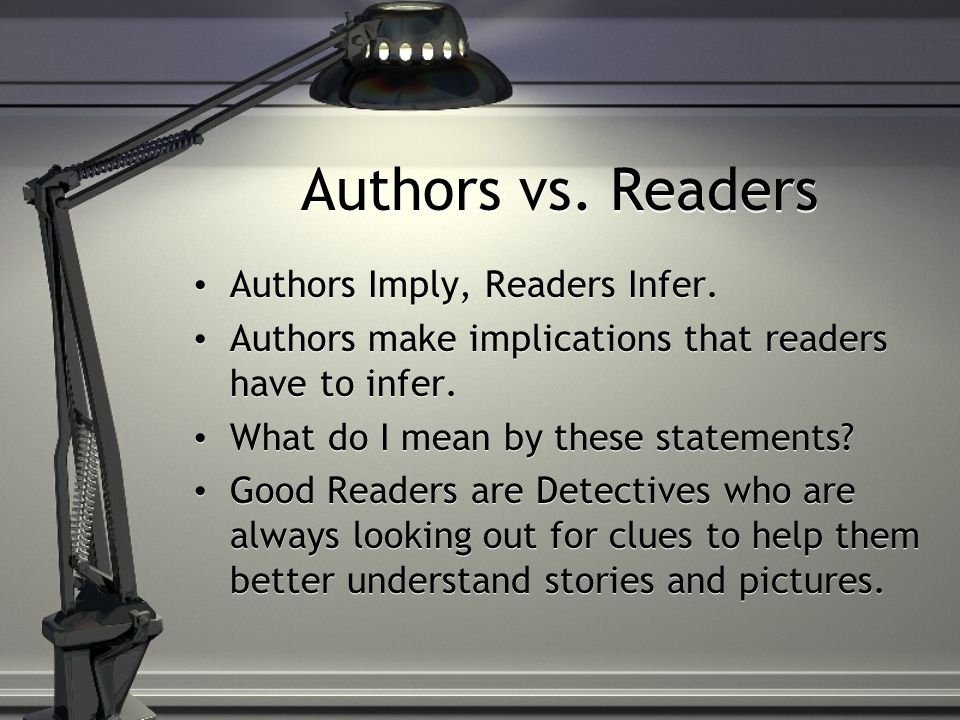
This was an interesting picture that I’ve been thinking about in regards to myself. Not as a reader, but as an author. Do any other authors wonder if their readers are getting the ideas that are in their head? What about if they come up with a different inference than you intended? These are questions and I’ve come up with this answer:
I write what I want and work off my own inferences, implications, and thoughts. That’s all I can do. My hope is that readers will see these or come up with their own ideas that will make me look at my books in a different light. I also acknowledge that there will always be readers who see things that I can’t figure out. You can’t please everybody and something that I see as an acceptable plot twist can be deemed a mistake by a reader. Being an author is about telling a story and not mind control. So, I trust my readers to follow their own inferences and hope it matches up.
Kind of a shaky explanation, but I’m still trying to figure it out. So, what about other authors and their readers?




 Legends of Windemere
Interesting. I’ve had people comment on something I wrote, and they got something I never intended out of it. It wasn’t bad, so I let them enjoy what they enjoyed. Sometimes I want to make a point, and it seems to get missed. I can work on that part.
LikeLike
I’ve gotten that too. Honestly, I find that most times it’s an interesting take that makes me think about the characters. Those are the conversations I enjoy with readers. I miss a few points too, but there’s only so much we can do there.
LikeLiked by 1 person
I love those conversations too.
LikeLike
I think it’s partly the nature of who we are as individuals. We see the world differently, so we pick up an authors cues in different ways. We might not see what the author sees or intended, but every reading experience is personal, so I don’t think that’s a bad thing. Sure, we have to be careful not to make assumptions that a reader will know the world as intimately as we do, but we shouldn’t spoon feed them either. Personally, I love it when readers see something I don’t see, or connect to my work in a way I never expected 🙂
LikeLike
I agree. Everyone has a different perspective, especially when the imagination comes into play. One thing I’ve noticed recently is that people seem to take their view and opinion as the only right way. That’s where I think things begin to get touchy.
LikeLiked by 1 person
Yes, I see your point. Nothing more irritating than the view ‘it’s my way or the highway!’
LikeLike
Reblogged this on O LADO ESCURO DA LUA.
LikeLike
Thanks for the reblog.
LikeLiked by 1 person
With a lot of my paintings being symbolic, I always know that the viewer will reach their own interpretation. That’s cool…as long as I am speaking to them somehow. With the books…well, some of them are odd and obscure, appealing to a minority readership. The principle is the same though, if it encourages thought and speculation, even if they miss what we were trying to get across, that’s okay.
What bugs me most as a writer is when I leave the symbolism and obscurity behind, write something crystal clear and almost spell it out…and still readers miss it. That is down to a number of things, but the fact that in those cases most readers focus on a single point seems to indicate that we, as readers, focus most on those things to which we can relate through personal experience.
LikeLike
I wonder if visual art is better at handling different interpretations than books. The crystal clear stuff getting deciphered into something obscure is what drove me nuts in poetry classes. Got into a few arguments over that. 🙂
LikeLike
I think visual art is more forgiving. Once we put words out there we almost automatically expect people to understand, yet wars have been fought over a few letters difference and a couple of altered words.
Poetry is more an expression of subjective feeling seeking to make itself understood… which means that all interpretation must be subjective also.So I am not sure we should seek to dissect and interpret poetry..only feel it.
LikeLike
More forgiving is the perfect way to describe it. Good point on poetry too. 🙂 Though, what about descriptive poetry that is trying to tell a story?
LikeLike
I still think that is meant to engage the emotions more than the mind… and if it wants to be understood as a narrative, it does need to be clear.
LikeLike
No two people think alike – the best you’ll get is ALMOST alike.
Just write for YOU and let the readers think what they will, chances are, you’ll all be happy 😃
LikeLike
Thanks. It does get creepy when you find people who do think alike. Usually means you wandered into a cult meeting instead of the weekly Bingo game. 😛
LikeLiked by 1 person
😱🙀😰😈
LikeLike
Great explanation. I agree with you.
LikeLike
Thanks. 🙂
LikeLike
Right on, Charles. Some readers seem to go through books like popcorn. They have a formula they like, and if you color outside those lines you’ll get complaints. But as writers we only tell a story. Interpreting it is up to the readers.
LikeLike
Well said. Popcorn readers . . . I like that term.
LikeLiked by 1 person
Really interesting read! I think the beauty of literature is that every reader will interpret it differently depending on where they are in life, what’s happened to them, what’s happening to them then. Keep writing what you love, that’s all you can do! 🙂
LikeLike
Thanks. Excellent point. Life experiences definitely mold our outlook. Best way to get a conversation going too.
LikeLike
Definitely! Having different outlooks are what keeps it interesting.
LikeLike