
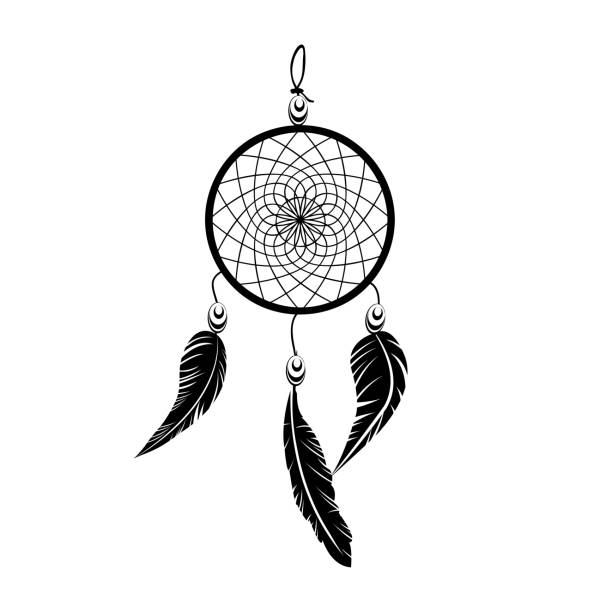
Dreamcatcher
Originally, I was going to do a ‘Ye Olde Shoppe’ for this, but then I realized how interesting dreamcatchers are. I used to have a small one as well as a large mandala having over my bed between graduating college and moving to Florida. Don’t remember where I got either and I think both went with my ex-wife. Never got a new one because of how my room is now, but that’s besides the point.
A dreamcatcher is a symbol from various Native American cultures. It is typically a hoop with a web in the middle and objects dangling from the bottom. All I could find with the origins is that it started with the Ojibwes then became more common during the Pan-Indian Movement of the 1960’s and 1970’s. I found various stories too, but the only thing in common is the presence of a spider.
The overall purpose of the dreamcatcher is to symbolize the circle of life, but there’s also the belief that it catches good dreams. This is why people hang it over their beds. It also wards off bad dreams, brings good fortune, and protects sleeping children. Not the easiest thing to pin down due to the commercialization of dreamcatchers. When this happened, the meaning got watered down and distorted. Kind of like how any religious/culturally significant object gets tainted by human greed and commercialization. I’m sure people will stop reading now and this is what will be discussed in the comments.
Now the parts of a dreamcatcher have meanings. I did my best to find the ones that supposedly came from the Ojibwe tradition, but you never know with the Internet:
- Hoop– This is the circular frame typically made wood. It signifies the circle of life, the orbit of the sun, and a balanced world.
- Web– Made from sinew or thread, this is always a complicated pattern. They don’t all look the same too. Based on a spider’s web, it signifies strength and resilience. The purpose is to catch negative dreams before they reach the sleeper.
- Eight Connection Points– While I’ve seen many dreamcatchers with more or less than this, there are supposed to be 8 points where the web meets the hoop. This is to signify the legs of a spider, which is an Ojibwe guardian spirit.
- There are other point systems that I found as well. Some use 13 for moon phases while others have 7 for a prophecy number. Two more are 6 points for the eagle and 5 points for a star.
- Feathers– The most common ‘decoration’ is what helps filter the dreams. Being connected to air and creativity, they let the good dreams get through. It was believed that the ones that reached the sleeper had messages from the spirits.
- Beads or Shells– These can symbolize two things. One is the spider who made the protective web. The other is that each one represents a good dream, which has been caught by the dreamcatcher. I’m not sure I understand that one since I thought those dreams were supposed to pass through.
- Cross– There is a type of dreamcatcher with a cross in the center. This is called a Medicine or Healing wheel used by shamans. The cross symbolizes the four cardinal directions.
That’s everything I could find about dreamcatchers with the information being found on various sites. I’m still not 100% certain how true everything is because I read a lot about them being culturally appropriated in the 60’s and 70’s. Not only by non-Native American cultures, but other tribes. So, there is a lot of distortion of their meaning, legends, and pieces. Hopefully, I relayed the general ideas though.
Anybody else have a dreamcatcher at some point? I was thinking of getting another, but I don’t feel like I should now.






I think I had one when I was a kid. I don’t know much about them.
LikeLike
Same here. Glad I looked it up.
LikeLike
We had a dream catcher when I was in graduate school. We knew the history thanks to a Native American friend.
LikeLike
Cool. Ashamed I didn’t know.
LikeLike
I just remember when friends went to church camp they made these and brought them home. (I was a heathen and didn’t go, also usually had a job.)
LikeLike
Which is funny because this came from a ‘heathen’ society according to the church.
LikeLiked by 1 person
I attended a workshop with my mom, my daughter and my aunt, run by Native Americans, in Sedona, Arizona. We each made one and I have mine hanging in my bedroom. They told us all about the history and your explanation sounds similar. They also taught us about the Medicine Wheel. It was very enlightening. They were eager to share their culture.
LikeLike
That’s so cool. Makes me want to find one and take my son to it. Though I don’t think I live in the right area.
LikeLiked by 1 person
I’ve never had a dream catcher but did understand its backstory. I always wondered why some people had them hanging from the mirror in their cars.
LikeLike
Good point. Maybe that whole ‘zoning out while driving’ thing? Means they won’t crash?
LikeLike
That would be a good thing.
LikeLike
I have never had one, though I do dream a lot! I did not know their origins , so thanks.
LikeLike
You’re welcome.
LikeLiked by 1 person
You are right that the symbol has been appropriated, but only to an extent. If you like the visual and it brings you happiness, I think you should choose a new one for yourself to enjoy. Part of moving on from loss can be to reclaim symbols like a dream catcher.
LikeLike
True, but the dreamcatcher seems low on my list of reclaimed symbols. Maybe one day when I have more space to decorate.
LikeLike
Never knew the 8 connection points symbolized spider legs. Sad how commercialization waters down the real cultural meaning though.
LikeLike
Yeah. Feel like that happens a lot in modern times.
LikeLike