
Yahoo Image Search
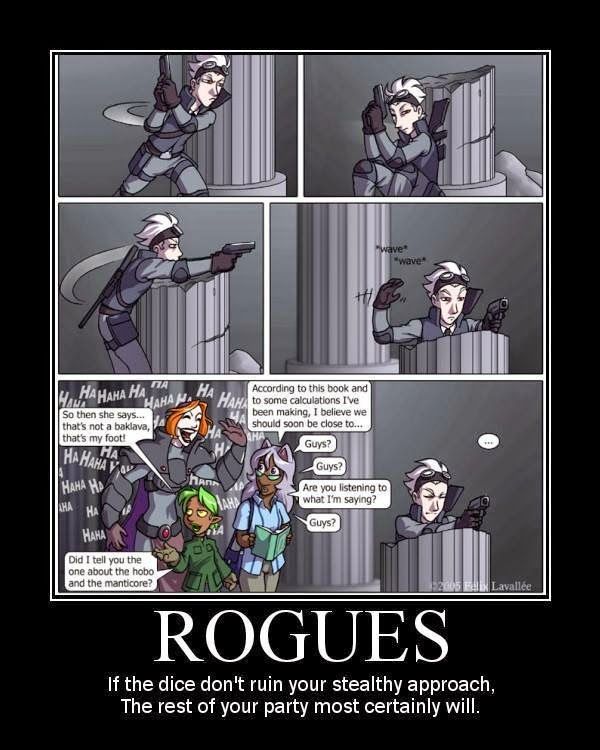
Anyone who has played Dungeons & Dragons, read fantasy, or even heard of thieves know that it’s tough putting them in groups. We seem to think they’re characters who will always be out for themselves. They’ll steal from their allies, sell people out for the smallest of reasons, and repeatedly do things that prevent them from being fully trusted. Now, some of this would make sense since many adventuring thieves require stealth and that’s not easy to do if you have a group. Still, that isn’t a reason to repeatedly have the thief on the outskirts of the party and always looking for a way to trade them all in for their favorite type of mead.
First, you have to consider the type of thief and what’s important to being a successful criminal. They won’t be exact criminals if they’re on the hero side, but some of the aspects jump over. Most importantly, a talented thief doesn’t ACT like a thief. This is where so many people go wrong in my opinion. Yes, it’s fun to have that character that can’t be trusted, but being seen as dishonest eliminates a lot of tricks that a thief needs. Without stats and dice rolls, it doesn’t matter if they character has a lot of charm if they’re always blatantly plotting something. There needs to be a subtlety to their antics because a real thief tries not to get caught. For example, stealing all of the treasure and hording it results in very heavy pockets and suspicion. Let the rest of the party keep their money and take from them when you need to. This is what Sari does and the others have basically accepted this, but at least they have money to spend when they need it too. No hard feelings there. Heck, it’s oddly endearing in a way.
Since thieves depend a lot on stealth and being unseen in combat, they might have to go it alone in a story. Not all the time, but slip away to scout for danger or use a battle to get in position for something else. Thieves aren’t cowards, but they aren’t normally the types to do a frontal assault. You may find them firing a bow or throwing daggers from the shadows or waiting for an opening to deliver a deathblow. Other times they run off to take care of another problem like a trap or locked door. Is this them using the fighters as distractions or bait? Yes, but they’re working with what they have and, hopefully, still helping. Again, this is an area where the betrayal is commonly used and it ignores the fact that the thief is on the good guy side. Is really smart to get the barbarian and fighter killed, which leaves you to face the thirteen ogres alone? Thieves need to be smart enough to work around all of the problems being in a group brings. They truly are the brains over brawn characters.
Also, not many thieves openly admit to being a thief. If they’re uncovered then they’ll fess up and make an excuse, but most use other terms. Sari calls herself a gypsy, which are a people in Windemere known for having thief skills. Nimby was calling himself a carpentry teacher until he was found out. Some simply claim to be adventurers even when they’re proving to be more interested in treasure than helping others. It’s all about the cover identity even among friends. Sure, the group might know they’re working with a thief, but that doesn’t mean the character should openly talk about it. More importantly, there should be an agreement or something where the rest of the party doesn’t out the thief all the time. I’ve been in games where another character will introduce everyone and say ‘this is so-and-so and he’s a thief’. That’s just rude and a reason why so many thieves probably do go for betrayal.
So, what do you think thieves in groups should do?




 Legends of Windemere
Being an upright citizen of the (larger and stronger) ape community, I can’t even imagine what thieves in groups should do, Charles – However, as a master of stealth myself (unless my wife hears the five pound note, in my concealed closed wallet, calling to her), I’d say – assess all situations quickly, strike unexpectedly and scarper (run away) before the foe has time to get back up 🦍
LikeLike
I think thieves in groups are more inclined to use the others as a means to an end. Partnered with a warrior or caster, you have someone with more power or can be a decoy. A thief can use their help to challenge more difficult obstacles where greater riches lie. Doesn’t hurt to be friendly with a healer either. Good strategy with the sneak attack. It’s the thief’s best weapon when fighting breaks out.
LikeLiked by 1 person
👍😃
LikeLike
I love playing rogues in D&D / Pathfinder. They’re the most fun for me, partly because I like taking the lion’s share of the action. You’re always first in line, first through the threshold, first to talk to the NPC, first to see the treasure and know what it’s worth. You set the pace of combat because the party’s tactics have to center around you. It’s just a good time.
I usually play my rogues with a pirate’s moral compass. He’s loyal to his friends and willing to go along with what the crew wants to do as long as he’s getting paid – even if it’s helping the knight kill some undead. It’s fun to look for a selfish angle that doesn’t betray your friends, while going along with the heroic adventure.
LikeLike
Not sure I was ever in a game where the Rogue was central. It was either the warrior or the person with area of effect attacks that set the pace. Thieves tended to lurk and wait for a backstab or flanking opportunity. Might have just been the local style.
I only played one thief, but he was a burglar and it didn’t come in handy that often. Avoiding that betrayal is always the tough part about playing a thief type.
LikeLiked by 1 person
Round these parts, no one plays tank so the first thing all the wizards have to do is cast some personal protection spells. Everyone finds a way to play a glass cannon, no matter their class 😉
I’m sure that has something to do with it.
LikeLike
What edition of D&D do you play? I kind of retired before 4th edition came out, so I wonder if the system changed. The wizards back then didn’t start with many protection spells.
LikeLike
I played 3e and Pathfinder mostly. First level wizards can pop off with Vanish, Mage Armor or Shield. 3rd level you can cast Mirror Image or Protection from Arrows.
The last wizard I played had shield proficiency and a mithril quickdraw buckler that I put a lot of resources in. His AC was incredible when stacked with Mage Armor, Protection from Evil and so on.
LikeLike
Don’t remember those three being available at first level for some reason. I usually played warriors, but tried a sorcerer once. Ended up using the Sleep spell with a surprising amount of versatility and ended up designing advanced spells around the ‘new school’. I’ll have to dig out my manuals again to check for those spells. Wizards using a shield something I ever saw either.
LikeLiked by 1 person
The wizard with a shield is cheese I figured out myself. Pretty original
LikeLike
Nice job. I was never good at the cheese stuff. Didn’t have a head for numbers, so I’d miss the opportunities.
LikeLiked by 1 person
I think thieves in groups should elect a spokesperson and then convince the rest of the world they are a charity open to donations. The other thing they could do is get involved in politics and their disguise would be perfect.
LikeLike
True. Though politics means no adventuring.
LikeLiked by 1 person
True.
LikeLike
Great post! I can’t help thinking of movies like The Italian Job, Now You See Me, and the Ocean’s 11 franchise. It’s hard for everyone to get along, especially if one of the people will ultimately betray the others.
LikeLike
The thing about those movies is that they’re all thieves with a common goal. So it’s the gang on a heist story. Things tend to get more complicated when it’s a thief on a team with non-thieves. Hard to hit the right balance between criminal and hero.
LikeLiked by 1 person
I know what you mean. Have you ever read The Lies of Locke Lamora?
LikeLike
Never read that one.
LikeLike
I haven’t given them a lot of thought. I’m more of the Indian scout kind of writer. They might do some pretty shady things if given the chance, but they are stealthy and can do the scouting and warning pretty well.
LikeLike
I think thieves in groups is traditionally a fantasy thing. Goes back to at least ‘The Hobbit’. Don’t really see thieves working well with others outside of that unless they’re on a redemption arc or are really a bad guy.
LikeLiked by 1 person
Seems like they’ve been around forever, even stealing magic harps or golden geese.
LikeLike
Yup. You can even say they go further by stealing fire for mankind
LikeLiked by 1 person
Good point. It’s funny how the point of view doesn’t look at them as thieves either. They are the hero, and a second thought about the theft isn’t even given. You’ve got me thinking about a future-future project again.
LikeLike
They’re all Robin Hood I guess.
LikeLiked by 1 person
Reblogged this on Author Don Massenzio.
LikeLike
Thanks for the reblog
LikeLiked by 1 person
You’re welcome.
LikeLike
I love this article, and I agree that not every thief has to be blatantly criminal. That could be one reason that the makers of D&D switched to calling the class Rogues instead.
Thieves can be good and noble. Think of Aladdin, in the Disney movie, who was stealing in order to eat. There are also some diplomats and spies, who may be nobly serving their countries but need to uncover secrets that foreign countries hold close. Finding these things out might call on a range of “rogue” skills from bribing the right people to breaking and entering — yet they’re doing it for their country.
LikeLike
Good point on the thieves becoming rogues. Probably helped stop everyone who played a thief from doing the backstabbing stereotype. Curious thing about the spy. A hero in one version, but the villain if you flip the POV.
LikeLike
Here’s a fun question for you. Robin Hood: rogue or ranger?
LikeLike
Both use stealth and tend to be seen as outsiders, but I’d say he was definitely a rogue. Rangers aren’t known for stealing and breaking the law. They’re usually just gruff and anti-social, which gets them a similar reputation.
LikeLike